Pornography isn’t just “out there” somewhere—it’s woven into the digital spaces kids use every day. With the average age of first exposure reported between 11–13 years old for many youth Owens, Eric W., Behun, Richard J., Manning, Jill C., & Reid, Rory C. (2012). The Impact of Internet Pornography on Adolescents: A Review of the Research. Sexual Addiction & Compulsivity: The Journal of Treatment & Prevention, 19(1–2), 99–122. https://doi.org/10.1080/10720162.2012.660431Copy Mesch, Gustavo S., & Isaacson, Michal. (2021). Internet Pornography Use Among Adolescents: Characteristics, Predictors, and Implications. Computers in Human Behavior, 114, 106578. https://doi.org/10.1016/j.chb.2020.106578Copy , it’s no longer a question of if but when they’ll encounter sexualized content online.
And parents rightfully are concerned, we’re often asked the following:
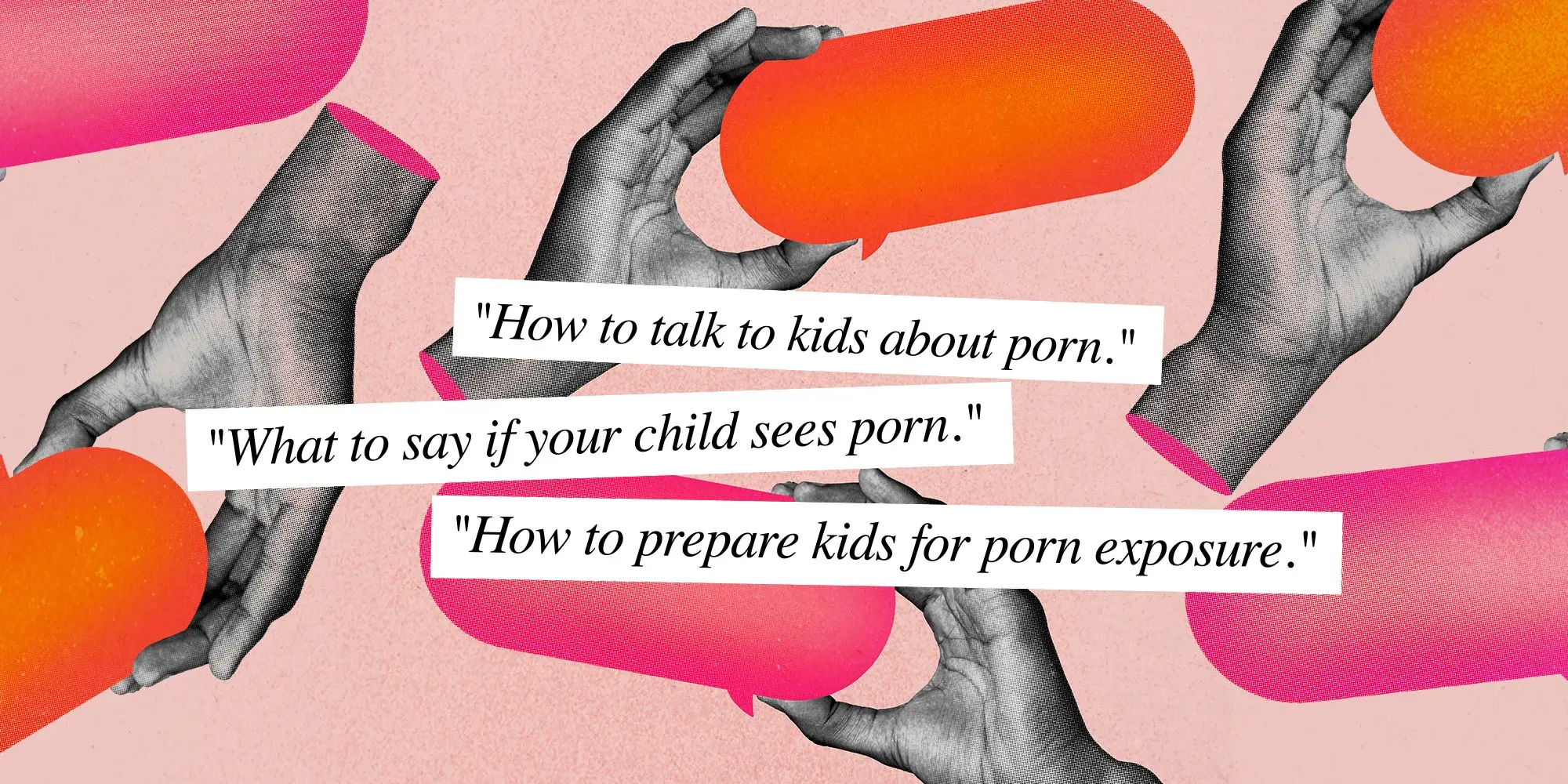
“What to do if your child sees porn.”
“How to talk to kids about porn.”
“What to say if your child sees porn.”
“How to prepare kids for porn exposure.”
That reality is your kid will likely see porn, and if you really think you’re the minority, you wouldn’t be here. We want you and the kids in your life to feel empowered. We want to help you know what to do when your child sees porn and how to prepare them for when it happens because, trust us, it will.
The right conversations and tools can prepare them for the moment someone shows them porn or when they come across it themselves.
No shame. No panic. Just clarity, confidence, and connection.
Why Preparing Kids Works Better Than Just Warning Them
Research shows that kids respond best to specific, rehearsed strategies when dealing with online risks—not vague warnings Livingstone, Sonia, Ólafsson, Kjartan, & Staksrud, Elisabeth. (2017). Evaluating the Effectiveness of Online Safety Education Programmes for Children and Young People: A Systematic Review. New Media & Society, 19(5), 575–597. https://doi.org/10.1177/1461444815626607Copy .
Just like a fire drill, practicing what to do ahead of time makes the real moment less overwhelming.
Equipping kids with simple scripts, exit strategies, and a safe adult to come to afterward with next steps reduces secrecy, increases reporting, and lowers shame Rothman, Emily F., Adhia, Aashika, Yin, Lauren, & Temple, Jeff R. (2021). A Scoping Review of Research on Preventing Sexual Abuse and Harmful Sexual Behavior Among Children and Adolescents. Child Abuse & Neglect, 122, 105392. https://doi.org/10.1016/j.chiabu.2021.105392Copy .
Start Here: “If You Ever See Something Sexual or Confusing, You’re Not in Trouble.”
Kids often avoid telling parents because they fear punishment or embarrassment. Research shows disclosure decreases when kids anticipate negative consequences Peter, Jochen, & Valkenburg, Patti M. (2016). Adolescents and Pornography: A Review of 20 Years of Research. The Journal of Sex Research, 53(4–5), 509–531. https://doi.org/10.1080/00224499.2016.1143441).Copy
A protective factor that improves outcomes?
Warm, open communication without shame.
Try starting with:
“If you ever see something sexual or confusing online, it doesn’t mean you’re bad or that you did anything wrong. You won’t be in trouble. The internet brings up strange things sometimes, and I’ll help you figure it out.”
This helps prevent secrecy and reduces anxiety if exposure happens. If they know confidently how you will respond, and it’s with no judgment and genuine love, they’ll be much more inclined to speak up.
Let them know you’d like to talk through a few scenarios to help them feel prepared when pornography comes up. If you haven’t yet discussed with you child what pornography is, it’s critical to prepare them. At Fight the New Drug, we do not define pornography, as what pornography is can be different for different individuals and families.
Whatever your family’s definition or threshold for pornography is, explain it to them in a way that is clear, straightforward, and uses anatomically correct names of body parts if they come up. We get it, it’s like having the sex talk all over, but the more comfortable and clear you can be, the more they will be too.
Our conversation guide is an invaluable tool that guides you through setting up the conversation, provides example icebreakers, and offers additional scripts and tips to help make the conversation successful.
Here are a few snippets from the conversation guide.
Conversation starters:
- “So, when was the last time you had a casual conversation about porn? Never? Me neither. Can we talk about it?”
- “Can I ask you about something that’s personal and might be kind of difficult to talk about?”
- “I’d like to share something with you. This is not easy for me to open up about, so I really need your love and support as I open up about this.”
For more information on how to have this initial conversation, check out our conversation blueprint.
Give Them Short, Practical Scripts to Handle Real-Life Scenarios
Kids don’t need a long explanation in the moment—they need quick responses they can use under pressure. Social pressure and curiosity are major drivers of teen porn consumption Martello, Gabriella, Ferrante, Dario, & Marci, Tiziana. (2023). Adolescents’ Consumption of Online Sexual Content: Motivations and Behavioral Patterns. Frontiers in Psychology, 14, 1102345. https://doi.org/10.3389/fpsyg.2023.1102345Copy .
1. If a friend shows them porn
Refusal scripts help youth resist risky peer pressure Duell, Natasha, Steinberg, Laurence, Icenogle, Grace, Chein, Jason, Chaudhary, Nandita, & et al. (2018). Age Patterns in Risk Taking Across the World. Developmental Review, 50, 1–23. https://doi.org/10.1016/j.dr.2018.05.001)Copy
Here are a few options you could practice with your child: have them rehearse whatever feels most natural and normal for them to say. Then practice how they would tell you about their experience
When a friend or someone else shows them porn:
- “Nah, I don’t want to see that.”
- “No thanks, that’s not my thing.”
- “Let’s watch something else.”
- “I’m out.”
- “I’m good, thanks.”
- “Hey, no thanks, I don’t watch that kind of stuff.”
- “Hey, I’m not into that. Did you know porn can actually really mess with you?”
- Follow up with how porn impacts mental health, relationships, and society. See our Fast Facts for more info.
- “Stop. I’m not into that.”
- “That crosses a line for me.”
- “Drop it.”
Some kids may prefer a more subtle exit:
- “I forgot something—be right back.”
- “I need to head out.”
- (In group chats) “Muting this.” Leaves conversation.
- “My Mom/Dad/Guardian is calling me.” or ” I forgot I have to call my Mom/Dad/Guardian back.”
How to tell a trusted Adult:
- “Someone showed me something on their phone that made me uncomfortable.”
- “My friend showed me a sexual video, and I looked away after I realized what it was.”
- “Someone sent something sexual in a chat, and I didn’t want to see it.”
- “I was shown something today I didn’t want to see. Can I tell you about it?”
- “A kid at school pulled up something inappropriate. I want to tell you so you know.”
- “I didn’t go looking for it, but someone else showed me porn.”
- “Hey, NAME (Mom, Dad, Guardian), I saw porn.”
2. If they stumble onto porn accidentally
Accidental exposure is extremely common: 43% of teens report unintentionally encountering pornography Lim, Megan S. C., Agius, Paul A., Carrotte, Elise R., Vella, Angela M., & Hellard, Margaret E. (2017). Young Australians’ Use of Pornography and Associations with Sexual Risk Behaviors. Journal of Adolescent Health, 60(6), 674–680. https://doi.org/10.1016/j.jadohealth.2016.12.016Copy .
To help you child prepare for this exposure, teach the three-step response:
Exit → Breathe → Tell someone.
Practicing this helps override the freeze response many teens describe.
Exit: Close whatever app, website, or browser where the porn appeared. Take a slow, deep breath and acknowledge how you are feeling. Startled? Frightened? Curious? Aroused? Excited? Nervous? Interested? Shameful?
As you walk through role-playing these scenarios, remind the child that any feelings associated with seeing porn are not “bad”; most often, they are totally normal.
Scripts for kids to tell a trusted adult:
- “I saw something online that made me uncomfortable.”
- “Something popped up, and I didn’t like it. Can we talk?”
- “I saw a video/picture that felt weird, and I want to tell you.”
- “I think I clicked something I shouldn’t have, and I’m not sure what to do.”
- “I saw something sexual online, and I didn’t want to. I need your help.”
- “A video came up that didn’t feel right. Can you help me figure it out?”
- “Hey, NAME (Mom, Dad, Guardian), I saw porn.”
3. If They Saw It Because They Went Looking for It
Curiosity-driven searches are one of the most common pathways into pornography use for kids and teens Vandenbosch, Laura, & Eggermont, Steven. (2013). Sexually Explicit Websites and Sexual Initiation: Reciprocal Relationships and the Role of Sexual Arousal. Journal of Adolescence, 36(4), 703–711. https://doi.org/10.1016/j.adolescence.2013.05.004.Copy This is not a “moral failing”—it is normal developmental curiosity mixed with easy access.
Stay calm—your reaction shapes whether they come to you again
Parental overreaction increases secrecy and decreases help-seekingLivingstone, Sonia, & Helsper, Ellen. (2008). Parental Mediation of Children’s Internet Use. Journal of Broadcasting & Electronic Media, 52(4), 581–599. https://doi.org/10.1080/08838150802437396Copy
Try:
“Thank you for being honest and for telling me. I’m glad we can talk about this, I’m here for you”
Normalize the curiosity, not the behavior.
Adolescents naturally seek novelty and exploration, depending on their age, hormones also come into play. (Steinberg, Laurence. (2014). Age of Opportunity: Lessons From the New Science of Adolescence. Houghton Mifflin Harcourt.Copy
You can acknowledge those feelings and curiosities without endorsing porn as a learning tool.
Try:
“It makes sense to be curious at your age. However, porn doesn’t teach healthy or realistic things about bodies or intimacy. Let’s talk about your questions.”
If they feel uncomfortable vocalizing their questions, they could write them out instead.
Explore the feeling behind the search
Motivation to seek out porn often includes curiosity, boredom, stress, or peer influencePeter, Jochen, & Valkenburg, Patti M. (2011). The Use of Sexually Explicit Internet Material and Its Antecedents: A Longitudinal Comparison of Adolescents and Adults. Journal of Communication, 61(4), 759–777. https://doi.org/10.1111/j.1460-2466.2011.01585.x)Copy
Ask:
- “What made you want to look it up?”
- “Did someone mention it?”
- “How did you feel afterward?”
Respond based on their body language, tone, and answers to show understanding.
Teach them what porn actually is—not what it pretends to be
Kids are smart, and while some of the research on the harms of porn might be difficult for them to comprehend, they can understand more than we think. Try sharing research, personal accounts, or other resources like our three-part docu-series designed for parents and teens to watch together.
Research links repeated pornography use to:
- Unrealistic expectations Peter, Jochen, & Valkenburg, Patti M. (2016). Adolescents and Pornography: A Review of 20 Years of Research. The Journal of Sex Research, 53(4–5), 509–531. https://doi.org/10.1080/00224499.2016.1143441Copy
- Distorted beliefs about consent and aggression Hald, Gert Martin, Malamuth, Neil M., & Yuen, Carlin. (2010). Pornography and Attitudes Supporting Violence Against Women: Revisiting the Relationship in Nonexperimental Studies. Aggressive Behavior, 36(1), 14–20. https://doi.org/10.1002/ab.20328Copy
- Harmful sexual scripts Vandenbosch, Laura, & Eggermont, Steven. (2013). Sexually Explicit Websites and Sexual Initiation. Journal of Adolescence, 36(4), 703–711. https://doi.org/10.1016/j.adolescence.2013.05.004Copy
- Negative mental health, including increased rates of depression and anxiety
Explain clearly:
Porn is not education. It doesn’t reflect healthy relationships, consent, or reality, and negatively impacts individuals, relationships, and society. For more information on the impacts of porn, become more educated yourself by checking out our Get the Facts Articles.
Create a reset plan for next time
Helping teens build emotional regulation reduces compulsive repetitionGola, Mateusz, Miyagi, Taku, & Kurosaki, Mutsumi. (2017). Compulsive Sexual Behavior: Neurobiological Mechanisms and Treatment. Journal of Behavioral Addictions, 6(2), 121–130. https://doi.org/10.1556/2006.6.2017.015Copy A practical plan:
- Pause for 30 seconds
- Redirect (go outside, text a friend, pursue a hobby)
- Ask, “What am I feeling right now?”
- Talk to a trusted adult
Keep the conversation ongoing
Having the first conversation will likely be your most difficult, but don’t stop there. Regular communication is a proven protective factor Rothman, Emily F., Adhia, Aashika, Yin, Lauren, & Temple, Jeff R. (2021). A Scoping Review of Research on Preventing Sexual Abuse and Harmful Sexual Behavior. Child Abuse & Neglect, 122, 105392. https://doi.org/10.1016/j.chiabu.2021.105392)Copy .Let them know:“You can always talk to me about this. I’m here for you.”
And then talk about it. Not just once, not just twice, but find opportunities to make it an ongoing normal conversation. The more it happens the more comfortable they will be coming to you about it.
Create a Simple, Repeatable Plan
A plan gives kids confidence and clarity. Try a visible approach for an additional reminder:
What to Do If You See Porn
- Turn away or close the device.
- Leave if someone else is showing it.
- Tell a trusted adult.
- Talk about how it made you feel.
- Move forward. You did the right thing.
Remember your tone matters more than saying the perfect word of phrase. Parental tone strongly influences how kids internalize sensitive conversations Davis, Kelly, Peck, Jessica H., Storholm, Erik D., & Rotheram-Borus, Mary Jane. (2019). Parental Communication and Adolescent Risk Behavior: A Meta-Analysis. Journal of Youth and Adolescence, 48(9), 1964–1977. https://doi.org/10.1007/s10964-019-01066-4Copy Your calmness communicates:“This is a safe topic. You can always come to me.”
That message stays with them far longer than the moment itself.
You can’t control every digital interaction your child experiences.
But you can teach them how to respond, what to say, and who to turn to.
By giving them:
- scripts,
- strategies,
- emotional tools,
- and shame-free support,
You’re equipping them with something pornography can’t compete with: Confidence, connection, and a plan.
Kids who feel prepared make stronger choices—online and offline.
*If you find your child is struggling with a compulsion or habit to consume pornography, there are resources available. We recommend connecting with a therapist or mental health professional. Additionally, apps like Fortify offer a free recovery solution for teens, allowing you, the parent or guardian, to serve as an accountability partner and support them throughout their healing journey. For more resources, click here
Your Support Matters Now More Than Ever
Most kids today are exposed to porn by the age of 12. By the time they’re teenagers, 75% of boys and 70% of girls have already viewed itRobb, M.B., & Mann, S. (2023). Teens and pornography. San Francisco, CA: Common Sense.Copy —often before they’ve had a single healthy conversation about it.
Even more concerning: over half of boys and nearly 40% of girls believe porn is a realistic depiction of sexMartellozzo, E., Monaghan, A., Adler, J. R., Davidson, J., Leyva, R., & Horvath, M. A. H. (2016). “I wasn’t sure it was normal to watch it”: A quantitative and qualitative examination of the impact of online pornography on the values, attitudes, beliefs and behaviours of children and young people. Middlesex University, NSPCC, & Office of the Children’s Commissioner.Copy . And among teens who have seen porn, more than 79% of teens use it to learn how to have sexRobb, M.B., & Mann, S. (2023). Teens and pornography. San Francisco, CA: Common Sense.Copy . That means millions of young people are getting sex ed from violent, degrading content, which becomes their baseline understanding of intimacy. Out of the most popular porn, 33%-88% of videos contain physical aggression and nonconsensual violence-related themesFritz, N., Malic, V., Paul, B., & Zhou, Y. (2020). A descriptive analysis of the types, targets, and relative frequency of aggression in mainstream pornography. Archives of Sexual Behavior, 49(8), 3041-3053. doi:10.1007/s10508-020-01773-0Copy Bridges et al., 2010, “Aggression and Sexual Behavior in Best-Selling Pornography Videos: A Content Analysis,” Violence Against Women.Copy .
From increasing rates of loneliness, depression, and self-doubt, to distorted views of sex, reduced relationship satisfaction, and riskier sexual behavior among teens, porn is impacting individuals, relationships, and society worldwideFight the New Drug. (2024, May). Get the Facts (Series of web articles). Fight the New Drug.Copy .
This is why Fight the New Drug exists—but we can’t do it without you.
Your donation directly fuels the creation of new educational resources, including our awareness-raising videos, podcasts, research-driven articles, engaging school presentations, and digital tools that reach youth where they are: online and in school. It equips individuals, parents, educators, and youth with trustworthy resources to start the conversation.
Will you join us? We’re grateful for whatever you can give—but a recurring donation makes the biggest difference. Every dollar directly supports our vital work, and every individual we reach decreases sexual exploitation. Let’s fight for real love: