
TLDR; Meta was ordered to pay $375 million after a New Mexico jury found the company liable for failing to protect children from exploitation on its social media platforms. The case, which began with an undercover investigation using decoy child accounts, revealed that minors could be contacted by predators and exposed to dangerous interactions despite known risks. This verdict highlights growing concerns about social media safety, platform accountability, and how online environments can enable child exploitation.
In a landmark decision that is already sending shockwaves through the tech industry, a New Mexico jury has ordered Meta to pay $375 million in damages after finding the company failed to adequately protect children from sexual exploitation on its platforms, according to reporting by NBC News. The case represents one of the most significant legal reckonings yet for a social media giant over child safety, and it raises urgent questions about how digital platforms expose minors to exploitation, including pornographic and abusive content.
This verdict is bigger than one company. It reflects a growing cultural and legal shift: society is beginning to recognize that what happens online, especially to young people, has real-world consequences.
What Happened in the Meta Lawsuit?
The lawsuit, brought by the state of New Mexico, accused Meta of enabling environments on Facebook and Instagram where predators could target, groom, and exploit minors. Evidence presented in court showed that harmful networks and exploitative content were able to circulate on Meta’s platforms despite internal awareness of risks.
Jurors ultimately concluded that Meta’s systems failed to adequately prevent the spread of child sexual exploitation material and did not sufficiently protect young users from predatory behavior, resulting in the $375 million judgment.
According to reporting by The Tech Buzz, in response to the verdict, Meta now faces pressure to significantly overhaul its algorithms and safety systems, particularly those that recommend content or connect users in ways that can amplify harm, especially to kids.
CNBC reports that the jury found Meta liable for violating New Mexico’s consumer protection laws related to child safety, marking a significant moment of accountability for one of the world’s largest social platforms
The lawsuit focused on how Meta’s design and systems allowed predatory behavior to occur, and essentially failed to protect minors even though they were aware of the risks.
This case moves beyond abstract concerns about “online safety” and assigns concrete accountability to big tech platforms.
For years, researchers, parents, and advocates have warned that social media platforms can act as accelerators for harmful content, including sexual exploitation. What this verdict signals is that those warnings are no longer theoretical, hey are legally actionable.
This case shows that exploitation isn’t separate from everyday online content; it often grows in the same digital spaces where sexualized content is already part of the norm.
The Undercover Investigation That Sparked the Case
Before the headlines, before the courtroom, there was an experiment.
Investigators working with the state of New Mexico created undercover accounts posing as minors under age 14, to see what would happen when a young user entered Meta’s platforms. What they uncovered became the backbone of the lawsuit and one of the most alarming parts of the case.
It didn’t take long for the profiles to receive attention from predators.
New Mexico Attorney General Raúl Torrez told CNBC a 13-year-old girl’s account “was simply inundated with images and targeted solicitations, which, frankly, I found to be shocking.”
The fake children accounts received sexually explicit material, and were reached out to by adults, which resulted in three arrests.
These aren’t random, rare occurrences for children. They happen every day.
“The decoy accounts with which these suspects engaged mirror the experience children can and are having on these platforms,” Torrez said.
He mentions social media platforms are dangerous for kids and a playground for predators to “hunt, groom, and victimize children in the real world.”
A former Meta employee, Arturo Bejar, mentioned that the platform is designed to connect you with what you’re interested in, even if that means kids.
“If your interest is little girls, it will be really good at connecting you with little girls,” Bejar told CNN.
And according to Torrez, “certain child exploitative content is 10 times more prevalent on social media platforms than it is on the porn site PornHub.”
These decoy accounts were quickly contacted by adult users who initiated sexually explicit conversations, often within a short period of time. In multiple instances, investigators reported that the accounts received inappropriate messages, pictures of genitalia, and more despite clear indicators that they were underage.
But the investigation went deeper than individual bad actors.
It revealed how platform design itself could contribute to risk.
Features intended to increase engagement, like friend suggestions, messaging tools, and algorithmic recommendations, were shown to sometimes facilitate connections between minors and adults in ways that created opportunities for grooming. Investigators argued that even when harmful behavior began, platform safeguards did not consistently intervene fast enough to stop escalation.
In other words, the issue wasn’t only that predators existed online, but also that the system made it easier for them to find and reach young users and didn’t protect them from harm.

A System, Not Just Individual Incidents
One of the most significant takeaways from the investigation is that it shifted the focus from isolated incidents to patterns.
The decoy accounts reportedly experienced:
- Repeated unsolicited contact from adults
- Escalating conversations that turned sexual
- Limited or delayed moderation responses
- Continued exposure to potentially harmful users through platform features
This pattern suggested that exploitation risk was not random; it was predictable within the system’s design.
When harm is predictable, it becomes preventable.
Why the Investigation Hit So Hard
For many people, concerns about online exploitation can feel distant or abstract. This undercover investigation changed that.
It recreated, in real time, what a young person might experience online, without filters, without assumptions, and without protection beyond what the platform itself provided.
The undercover accounts weren’t hidden deep in obscure corners of the internet. They existed exactly where millions of real young users spend their time, scrolling, messaging, connecting.
Even when warning signs appeared, intervention didn’t always follow immediately.
And what it showed was deeply human:
A minor logs on.
A message appears.
Another follows.
Boundaries are tested.
And too often, no one steps in.
That reality helps explain why jurors ultimately sided with the state. The evidence didn’t just describe risk, it demonstrated it.
Connecting the Investigation to the Bigger Picture
The findings from this investigation align with broader research on digital environments and sexualized content. The investigation mainly considered the exploitation of the minors’ faces from solicitation and interactions facilitated by predators on the platform, not what the child is also seeing while scrolling.
When platforms consistently expose users to high volumes of stimulating or boundary-pushing material, it can shape expectations and normalize certain interactions over time through neuroplasticity.Pitchers, K. K., Vialou, V., Nestler, E. J., Laviolette, S. R., Lehman, M. N., & Coolen, L. M., 2013. Natural and drug rewards act on common neural plasticity mechanisms with ΔFosB as a key mediator. The Journal of Neuroscience, 33(8), 3434–3442. https://doi.org/10.1523/JNEUROSCI.4881-12.2013Copy
Over time, repeated exposure to exaggerated or highly stimulating sexual content can influence what individuals perceive as normal or acceptable.Kühn, S., & Gallinat, J., 2014. Brain structure and functional connectivity associated with pornography consumption: the brain on porn. JAMA Psychiatry, 71(7), 827–834. https://doi.org/10.1001/jamapsychiatry.2014.93Copy
In this context, platform structure, content exposure, and user behavior intersect, creating environments where exploitation can more easily take root. The exploitative and pornified content kids are seeing online is, in a sense, grooming them for real-world experiences.
This wasn’t just a test. It was a turning point.
By documenting how quickly and consistently risky interactions could occur, the investigation reframed the issue:
- From “bad individuals using platforms.”
- To “platform systems that can enable harm.”
Yet how many kids have accounts on these platforms without ever realizing the dangers they are facing?
That shift is exactly what led to legal accountability, and why this case is being watched so closely.
Because if one investigation can reveal this much, it raises a bigger question:
How many similar interactions happen every day, unseen and unreported?
How Exploitation Happens on Social Platforms
Cases like the Meta lawsuit illustrate patterns that researchers and investigators have documented for years:
- Predators use direct messaging features to contact minors
- Algorithms may recommend connections or content that increase exposure to harmful networks
- Sexualized content can normalize boundary violations
- Anonymous or pseudonymous accounts reduce accountability
The National Center for Missing & Exploited Children has reported millions of cases of suspected child sexual exploitation online annually, reflecting the scale of the issue.
When platforms fail to intervene early, these systems can create pathways that move from initial contact to grooming and exploitation.
The Mental Health Toll on Young People
Beyond immediate safety concerns, exposure to sexualized or exploitative content is linked to broader mental health impacts.
Studies have found associations between pornography consumption and outcomes such as depression, anxiety, loneliness, and lower self-esteem.Harper, C., & Hodgins, D. C., 2016. Examining correlates of problematic internet pornography use among university students. Journal of Behavioral Addictions, 5(2), 179–191. https://doi.org/10.1556/2006.5.2016.022Copy
Research also shows a bidirectional relationship between loneliness and pornography use, where each reinforces the other.Butler, M. H., Pereyra, S. A., Draper, T. W., Leonhardt, N. D., & Skinner, K. B., 2018. Pornography use and loneliness: A bidirectional recursive model and pilot investigation. Journal of Sex & Marital Therapy, 44(2), 127–137. https://doi.org/10.1080/0092623X.2017.1321601)Copy
These findings highlight how digital environments that promote isolation and objectification can make young users more vulnerable—not only to mental health struggles but also to exploitation.
Where Do We Go From Here?
The $375 million verdict is likely just the beginning. And of course, Meta plans to fight it.
Lawmakers, regulators, and advocacy groups are increasingly calling for:
- Stronger age verification systems
- Algorithm transparency and accountability
- Faster removal of exploitative content
- Greater corporate responsibility for user safety
While at Fight the New Drug, we are non-legislative, we do support legislation protecting kids from exploitation.
More can be done for these platforms to disclose the dangers and to keep kids safe.
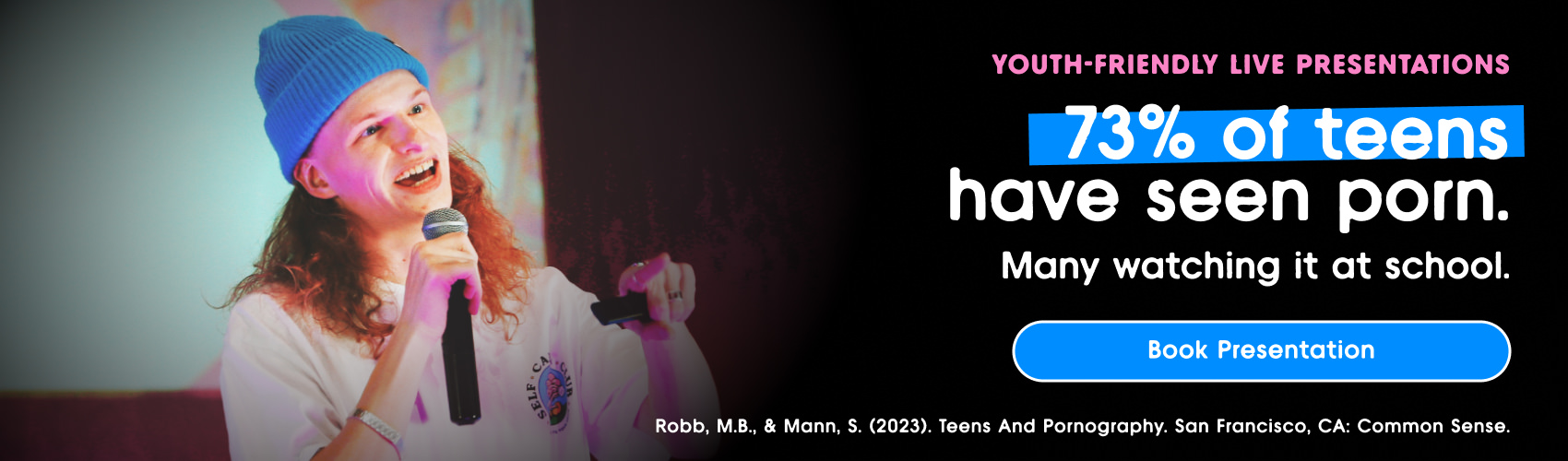
As parents, caregivers, educators, leaders, and advocates for the children in our lives, we must inform and protect through education.
Digital safety and conversations on the harmful effects of pornography have never been more crucial. Be transparent with your kids about the realities happening online and set boundaries to keep them safe.
Having honest, open communication on these topics can make all of the difference. If you’re not sure where to begin, check out our conversion blueprint.
A Turning Point for Online Safety
This case represents a cultural shift toward accountability in the digital age.
It acknowledges what survivors, researchers, and advocates have long emphasized: online spaces shape real lives. When those spaces allow exploitation, the consequences ripple far beyond the screen.
The question now is whether this moment leads to lasting change or fades into another warning in the feed.
Your Support Matters Now More Than Ever
Most kids today are exposed to porn by the age of 12. By the time they’re teenagers, 75% of boys and 70% of girls have already viewed itRobb, M.B., & Mann, S. (2023). Teens and pornography. San Francisco, CA: Common Sense.Copy —often before they’ve had a single healthy conversation about it.
Even more concerning: over half of boys and nearly 40% of girls believe porn is a realistic depiction of sexMartellozzo, E., Monaghan, A., Adler, J. R., Davidson, J., Leyva, R., & Horvath, M. A. H. (2016). “I wasn’t sure it was normal to watch it”: A quantitative and qualitative examination of the impact of online pornography on the values, attitudes, beliefs and behaviours of children and young people. Middlesex University, NSPCC, & Office of the Children’s Commissioner.Copy . And among teens who have seen porn, more than 79% of teens use it to learn how to have sexRobb, M.B., & Mann, S. (2023). Teens and pornography. San Francisco, CA: Common Sense.Copy . That means millions of young people are getting sex ed from violent, degrading content, which becomes their baseline understanding of intimacy. Out of the most popular porn, 33%-88% of videos contain physical aggression and nonconsensual violence-related themesFritz, N., Malic, V., Paul, B., & Zhou, Y. (2020). A descriptive analysis of the types, targets, and relative frequency of aggression in mainstream pornography. Archives of Sexual Behavior, 49(8), 3041-3053. doi:10.1007/s10508-020-01773-0Copy Bridges et al., 2010, “Aggression and Sexual Behavior in Best-Selling Pornography Videos: A Content Analysis,” Violence Against Women.Copy .
From increasing rates of loneliness, depression, and self-doubt, to distorted views of sex, reduced relationship satisfaction, and riskier sexual behavior among teens, porn is impacting individuals, relationships, and society worldwideFight the New Drug. (2024, May). Get the Facts (Series of web articles). Fight the New Drug.Copy .
This is why Fight the New Drug exists—but we can’t do it without you.
Your donation directly fuels the creation of new educational resources, including our awareness-raising videos, podcasts, research-driven articles, engaging school presentations, and digital tools that reach youth where they are: online and in school. It equips individuals, parents, educators, and youth with trustworthy resources to start the conversation.
Will you join us? We’re grateful for whatever you can give—but a recurring donation makes the biggest difference. Every dollar directly supports our vital work, and every individual we reach decreases sexual exploitation. Let’s fight for real love: