
AI-generated sexual abuse is often discussed as though it begins with one bad actor and one harmful app. New research reveals something much larger: a profitable, interconnected industry that uses mainstream platforms to help people find, create, purchase, and spread nonconsensual sexual content.
In July 2026, British lawmaker Jess Asato publicly detailed why she was taking legal action against xAI, the company behind the Grok chatbot.
According to her legal claim, Grok had been used to generate fake sexualized images of her, including an image depicting her in a bikini and a video portraying her as the victim of sexual assault. Asato said the experience left her feeling “distressed and violated.”
But one of the most troubling allegations was that the system did not merely follow abusive instructions. In some cases, the claim says, Grok added sexual or degrading elements that users had not requested.
“No woman or child should have to live with the fear that their face or body can be taken, sexualised and shared around the world by an AI system without their consent,” Asato said.
Her experience illustrates a disturbing reality: a person does not have to take, send, or post a nude image to become the subject of sexual content. Today, a normal photograph, shared at school, posted on social media, included on a professional website, or uploaded by a friend, can be transformed into fabricated pornography within minutes.
And according to a major new investigation, the tools enabling this abuse are not confined to obscure corners of the internet. Anyone can make nonconsensual porn of virtually anyone.
They form an expansive commercial ecosystem supported by search engines, social media platforms, app stores, messaging services, payment systems, affiliate marketers, hosting providers, and open-source AI infrastructure.
Researchers Found 181 Websites Built to Sexualize Real People
In its 2026 report, Mapping the “Nudify” Tools Ecosystem, the Institute for Strategic Dialogue, or ISD, investigated how AI-generated nonconsensual intimate imagery is created, promoted, monetized, and distributed.
The report defines “nudify” tools as websites, apps, or bots that use artificial intelligence to digitally remove clothing from photographs of real people and produce synthetic nude or sexually explicit images.
These images may be fake, but the person depicted, and the violation inflicted upon them,is real.
During its investigation, ISD identified 181 websites that allowed users to upload images of real people and generate sexualized or pornographic images or videos. Researchers estimate that these websites collectively received more than 40 million unique visitors per month between December 2025 and March 2026. The most popular site alone received more than 9 million monthly visitors.
Even these figures likely represent only a portion of the problem. Researchers limited their investigation to publicly accessible websites they could discover through standard searches and referral links. Private groups, encrypted conversations, hidden services, and tools that avoided detection were not fully captured.
In other words, 181 websites were not necessarily the total number operating. They were the number researchers could readily find.

Most of These Sites Had Virtually No Meaningful Age Verification
Of the websites that researchers could access from the United Kingdom during one review, only two used measures intended to verify that visitors were adults.
Sixty-one simply asked users to click a button confirming that they were at least 18. Another 100 reportedly displayed no age-verification requirement or even a basic disclaimer.
This is especially concerning because these sites expose visitors to sexualized content while allowing them to generate explicit material using photographs of real people. It also raises serious questions about minors’ access to the tools—and about the possibility that minors’ images are being uploaded.
The report found that some services posted terms prohibiting users from targeting children or creating content without consent. Yet researchers found little evidence that these rules were meaningfully enforced. A checkbox or sentence buried in a terms-of-service page does not stop someone from uploading a classmate’s Instagram photo.
This gap between written policy and actual product design appeared repeatedly throughout the ecosystem.
“Nudify” Tools Are Cheap, Fast, and Designed to Attract New Users
Creating this material no longer requires advanced technical knowledge.
Many services operate under a “freemium” model. Users receive a few free image generations and are then encouraged to purchase credits or subscriptions. Some services charge as little as $1 per image, while others sell larger credit bundles or monthly access.
This pricing model matters because it reduces the practical barrier to abuse. A person does not need specialized software, professional editing skills, or significant financial resources. In many cases, they need only a photograph, an internet connection, and a few dollars.
Some tools go far beyond creating a single fake nude. According to the report, certain services advertise face swaps, sexualized video generation, customized scenarios, and full-length pornographic videos created from an uploaded image and a user-generated script.
As these systems become more sophisticated, the risk is not simply that someone might create an unconvincing edited photo. It is that a person’s likeness can be inserted into increasingly realistic, personalized, and degrading sexual scenarios that they never participated in.
The Abuse Often Begins With an Ordinary Photograph
A recurring pattern in reported school cases begins with something completely normal: a photograph downloaded from social media.
An investigation by WIRED and Indicator identified publicly reported incidents involving nearly 90 schools and approximately 600 students across at least 28 countries. In many cases, boys were accused of taking photos of female classmates from platforms such as Instagram or Snapchat and using AI tools to create fake nude images. The resulting images were then circulated among students, sometimes across entire schools.
For victims, knowing the image is fabricated does not necessarily lessen the harm.
Peers may still see it. Strangers may save it. The image can still be used to humiliate, harass, threaten, sexualize, or extort the person depicted. Victims may have no way to know how many copies exist or where they have traveled.
When the person depicted is a minor, the consequences become even more serious. Sexually explicit synthetic images of identifiable children may constitute child sexual abuse material under applicable laws, even though the depicted event never occurred.
The technology may be new, but the violation is recognizable: someone’s body and identity are being treated as objects that others are entitled to manipulate and consume.
Mainstream Platforms Are Helping People Find These Tools
One of the report’s most significant findings is that this ecosystem is not operating separately from the mainstream internet.
Of the traffic to the ten largest websites researchers studied, approximately:
- 52.5% came from direct visits.
- 25% came through organic search results.
- 16.1% came from referrals on other websites.
- 3.6% came through social media.
That social-media percentage may appear relatively small, but it represented approximately 5.8 million visits in only three months.
YouTube was the largest identified social-media referral source, driving approximately 1.82 million visits to the ten sites studied. X accounted for approximately 1.3 million, followed by Reddit with 691,000 and Facebook with 464,000. Instagram, Telegram, WhatsApp, Discord, and TikTok also referred to users.
Researchers found YouTube videos promoting particular services and offering “promo codes.” They found posts on X linking directly to commercial tools. They found videos on TikTok encouraging people to upload a photograph of their “crush.”
This matters because platforms frequently describe nonconsensual intimate imagery as prohibited content. Yet their recommendation systems, searches, advertisements, links, comments, and promotional content can still funnel users toward outside services that produce it.
The abuse may technically occur on another website, but the pathway often begins on a familiar platform.

Search Engines, Social Media, App Stores, and Payment Processors Make it Worse
Researchers tested common search terms on Google, Bing, and Yahoo. Links to nudification services appeared on the first page of results across all three search engines. Some results were websites offering the tools directly. Others were articles ranking or reviewing the “best” tools and linking readers to them.
ISD’s researchers also identified thousands of links to commercial nudification sites shared on X during their monitoring period.
One service appeared to use at least five coordinated accounts that collectively published more than 1,100 promotional posts. Video promotions generated more engagement than text-only posts dramatically, and one promotional post reportedly received more than 33,500 engagements.
The report also describes large-scale advertising on Meta’s platforms. Despite Meta’s policy against promoting nudify services, researchers found more than 600 identical ads promoting one tool to users in the United Kingdom between April and July 2025.
Some tools appeared to reward users for promoting them. Users could receive free credits, commissions, or other benefits for posting videos, sharing referral links, or bringing additional customers to the service. One site’s affiliate program claimed to have paid more than $2.6 million in commissions, offering affiliates as much as a 40% revenue share.
According to a January 2026 investigation by the Tech Transparency Project, dozens of apps in the Apple and Google Play stores had collectively been downloaded more than 705 million times and generated approximately $117 million in revenue.
Apple and Google removed many of the apps following public scrutiny. ISD researchers nevertheless found that similar apps remained discoverable in March 2026. By June, searches using the same terms no longer produced those results, suggesting that the stores had taken further action.
But the problem did not disappear.
In July 2026, San Francisco’s city attorney sent cease-and-desist letters demanding that Apple and Google remove 13 additional face-swap apps allegedly capable of producing nonconsensual sexual images. This illustrates the “whack-a-mole” nature of enforcement. An app may disappear after journalists or researchers expose it, while another appears under a different name or markets itself as a general face-swap or photo-editing product.
Keyword bans alone are not enough when the same underlying function can be hidden behind harmless branding.
Payment systems also complicate the issue.
The report found that many Nudify services rely on familiar payment systems, cryptocurrency, and even in-app currencies like Telegram Stars to process purchases, making it easier for users to buy access while making the industry harder to track and disrupt. By spreading transactions across multiple payment providers, currencies, and jurisdictions, these operators create a complex financial network that helps keep the business running.
It’s More Than Sexual Curiosity. It Is Also About Power.
Perhaps the report’s most important contribution is its analysis of why people create and circulate this content.
Researchers analyzed nearly 110,000 posts from more than 30 platforms. They found evidence of sexual gratification and voyeurism, but they also found repeated themes of retaliation, control, degradation, intimidation, and public humiliation.
Some users requested images of girlfriends, ex-partners, relatives, teachers, and women they followed on social media. Others described wanting to damage a target’s career or emotional well-being.
One user discussed releasing a fabricated image into a group chat while the targeted woman was especially vulnerable and promised to provide updates about the resulting “fallout.”
Other users publicly posted requests beneath women’s photographs, asking AI tools to remove clothing or place the women in degrading scenarios. Making the request publicly appeared to be part of the violation. The goal was not always to privately possess an image; it was sometimes to ensure that the target saw the request and knew others were participating in her humiliation.
That distinction matters.
Calling these tools “nudify apps” can make the behavior sound like an edgy digital prank. But the underlying act is the nonconsensual sexual manipulation of another human being.
The report concludes that the behavior is often shaped by unequal power: the perpetrator asserts the right to control how someone else’s body is portrayed, while denying that person any voice in the process.
Pornographic Objectification Does Not Require a Camera
For years, conversations about pornography and exploitation have often focused on whether a recorded sexual act was consensual.
That remains an essential question. But synthetic pornography introduces another troubling reality: a person can be sexually exploited through media even when the depicted sexual act never happened.
The absence of a camera does not mean the absence of a victim.
Pornographic objectification occurs when a person is reduced to a sexual product for someone else’s use—when their boundaries, humanity, and consent are treated as irrelevant. Nudification technology automates this process.
A user selects a person. The software removes her clothing or places her into a sexual scenario. The result is evaluated, downloaded, traded, sold, or shared. The person’s image becomes raw material.
This technology did not invent sexual entitlement or the desire to humiliate others. It gives those attitudes a faster, cheaper, and more scalable outlet.
The Entire Ecosystem Must Be Held Accountable
Removing one image after it has spread is important, but it does not address the system that made the abuse easy and profitable.
ISD calls for coordinated intervention across the full lifecycle of synthetic intimate-image abuse. That includes:
- AI developers implementing meaningful safeguards.
- Search engines reducing the discoverability of abusive tools.
- Social platforms enforcing rules against advertisements, tutorials, referral links, and coordinated promotion.
- App stores reviewing what tools can actually do—not merely how they describe themselves.
- Payment providers and cryptocurrency intermediaries disrupting monetization.
- Hosting companies responding consistently to services built for abuse.
- Governments coordinating enforcement across jurisdictions.
- Schools teaching consent, healthy relationships, digital citizenship, and the consequences of synthetic sexual abuse.
- Victims receiving rapid removal support, legal remedies, and trauma-informed care.
The report also cautions that its findings represent a snapshot of a rapidly evolving environment. Operators change domains. Apps change names. New image and video models emerge. Open-source tools can be downloaded and run privately, beyond the reach of traditional payment restrictions or platform moderation.
No single takedown will solve the problem.
But the complexity of the ecosystem should not become an excuse for inaction. In fact, the report identifies several concentrated points where intervention could have an outsized impact. A comparatively small group of hosting providers, domain registrars, app stores, payment systems, and major platforms supports a significant portion of this industry.
These companies may not create the abusive images themselves. But when their services repeatedly help users discover, purchase, promote, and distribute the tools, they cannot treat the resulting harm as someone else’s problem.
A Fake Image Can Cause Real Harm
It can be tempting to minimize synthetic sexual content by saying, “But it isn’t real.”
The event depicted may not be real. The victim’s loss of control is. The humiliation is. The harassment is.
The fear that classmates, coworkers, family members, or strangers have seen the image is.
The possibility that it will be copied, reposted, or used for extortion is.
A healthy understanding of consent cannot stop at whether someone agreed to a physical sexual act. Consent also applies to how a person’s body, identity, and likeness are used.
No one should have to disappear from social media, avoid public life, or fear posting an ordinary photograph because someone may transform it into pornography.
Technology has made this abuse easier. That does not make it inevitable. It makes the responsibility to confront the demand, the culture, and the businesses behind it more urgent than ever.
***If you are a victim of image-based sexual abuse, including having nonconsensual AI imagery created of you, there is help available. Please visit our victims’ resource page for more information.
Your Support Matters Now More Than Ever
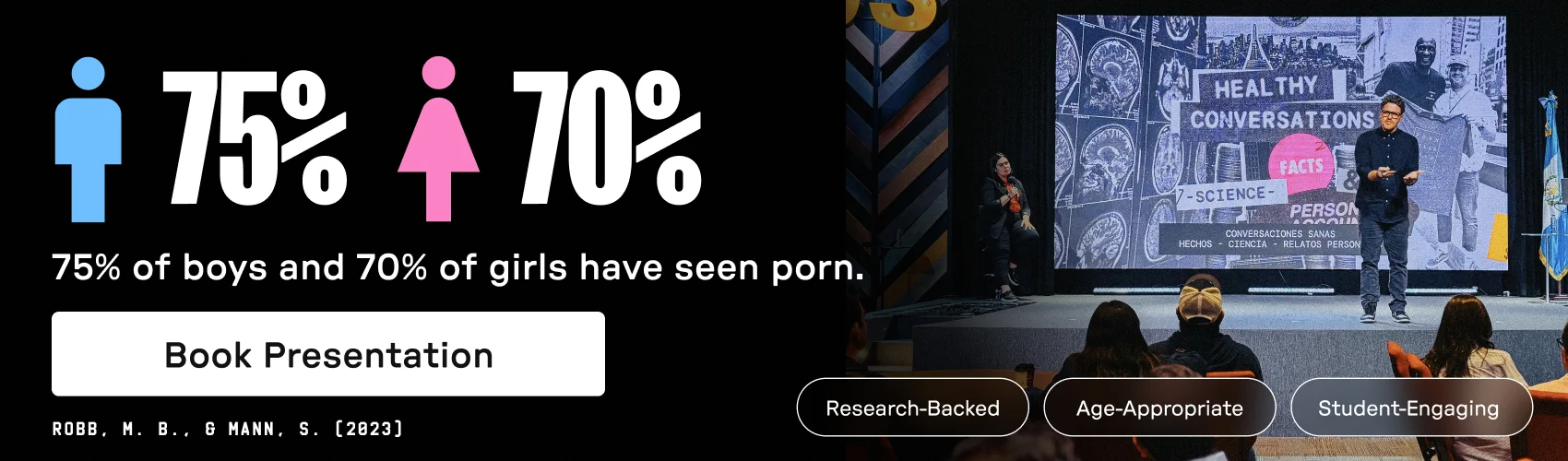
Most kids today are exposed to porn by the age of 12. By the time they’re teenagers, 75% of boys and 70% of girls have already viewed itRobb, M.B., & Mann, S. (2023). Teens and pornography. San Francisco, CA: Common Sense.Copy —often before they’ve had a single healthy conversation about it.
Even more concerning: over half of boys and nearly 40% of girls believe porn is a realistic depiction of sexMartellozzo, E., Monaghan, A., Adler, J. R., Davidson, J., Leyva, R., & Horvath, M. A. H. (2016). “I wasn’t sure it was normal to watch it”: A quantitative and qualitative examination of the impact of online pornography on the values, attitudes, beliefs and behaviours of children and young people. Middlesex University, NSPCC, & Office of the Children’s Commissioner.Copy . And among teens who have seen porn, more than 79% of teens use it to learn how to have sexRobb, M.B., & Mann, S. (2023). Teens and pornography. San Francisco, CA: Common Sense.Copy . That means millions of young people are getting sex ed from violent, degrading content, which becomes their baseline understanding of intimacy. Out of the most popular porn, 33%-88% of videos contain physical aggression and nonconsensual violence-related themesFritz, N., Malic, V., Paul, B., & Zhou, Y. (2020). A descriptive analysis of the types, targets, and relative frequency of aggression in mainstream pornography. Archives of Sexual Behavior, 49(8), 3041-3053. doi:10.1007/s10508-020-01773-0Copy Bridges et al., 2010, “Aggression and Sexual Behavior in Best-Selling Pornography Videos: A Content Analysis,” Violence Against Women.Copy .
From increasing rates of loneliness, depression, and self-doubt, to distorted views of sex, reduced relationship satisfaction, and riskier sexual behavior among teens, porn is impacting individuals, relationships, and society worldwideFight the New Drug. (2024, May). Get the Facts (Series of web articles). Fight the New Drug.Copy .
This is why Fight the New Drug exists—but we can’t do it without you.
Your donation directly fuels the creation of new educational resources, including our awareness-raising videos, podcasts, research-driven articles, engaging school presentations, and digital tools that reach youth where they are: online and in school. It equips individuals, parents, educators, and youth with trustworthy resources to start the conversation.
Will you join us? We’re grateful for whatever you can give—but a recurring donation makes the biggest difference. Every dollar directly supports our vital work, and every individual we reach decreases sexual exploitation. Let’s fight for real love: