Trigger warning: This article contains descriptions of sexual abuse. Reader discretion advised.
There were no warning signs. No memory of fear. No moment where she could say no.
While she lay unconscious, investigators say her husband invited strangers into their home, one after another. Over time, dozens of men allegedly entered her home, her bed, and sexually assaulted her while she was drugged, asleep, and unable to respond.People. (2026). Gisèle Pelicot: 51 rapists, same excuse. https://people.com/gisele-pelicot-51-rapists-same-excuse-11943612; Copy
She had no idea it was happening.
Not that night.
Not the next.
Not during any of the time over 50 men assaulted her.
What she would eventually discover was not a single act of betrayal, but a pattern—documented, repeated, and carried out by perpetrators who later claimed they believed it was acceptable.
Gisèle only discovered the years of abuse after her husband was caught attempting to take pictures up women’s skirts. Investigators later found video evidence of Gisèle being raped over and over on his laptop.
Investigators later told her what they discovered.
In an interview with CBS she says,
“[The investigator] said, ‘Mrs. Pelicot, do you recognize yourself in these photos?'” she recalled. “And I said, ‘No, it’s not me.’ Then he said, ‘This is your bedroom.’ And I see a woman I don’t recognize at all, completely asleep with a man beside her. I don’t know this man. And then he says, ‘I’m going to tell you something shocking: You were raped by 53 individuals.’ My world collapsed.”
“Yes, it was me, but this woman was lifeless. . . She looked dead.”
“On this video, we see a human being, being treated as an object. We see men who desecrate a human body, who desecrate someone, Gisèle, who is in profound distress, because her life was at risk at every moment where she was drugged and abused.”
In France, victims of sexual assault are kept anonymous for their protection, but Gisele chose to let her name be known, to face her accuser, and to bravely raise a voice for survivors everywhere. Her husband and the perpetrators were all sentenced.
She explained that decision as a way to shift shame away from survivors and toward perpetrators. “I was sacrificed on the altar of vice,” she said, describing years of abuse she endured without her knowledge.
In another interview, she expressed a deeper purpose for speaking out: she wanted “all women who have been victims of rape to say: Madame Pelicot did it, I can do it too”.PBS NewsHour. (2026). Rape survivor Gisèle Pelicot’s ‘A Hymn to Life’ chronicles resilience after abuse. https://www.pbs.org/newshour/show/rape-survivor-gisele-pelicots-a-hymn-to-life-chronicles-resilience-after-abuseCopy
Her words are not only testimony—they are a call to confront what happened.
According to multiple investigations, Pelicot’s husband systematically drugged her, leaving her unconscious, and invited other men into their home to assault her.National Post. (2026). Gisèle Pelicot vs. a pack of rapists. https://nationalpost.com/feature/gisele-pelicot-vs-a-pack-of-rapistsCopy
Over 50 men were involved, some of whom allegedly returned multiple times.
Many of the accused reportedly claimed they believed the situation was consensual because her husband had arranged it.People. (2026). Gisèle Pelicot: 51 rapists, same excuse. https://people.com/gisele-pelicot-51-rapists-same-excuse-11943612Copy
But Pelicot has been clear: “I didn’t give my consent.”
She could not. She was unconscious.
What Happened to Gisèle Pelicot Is Happening to Others
As investigators and journalists began to uncover the details of Pelicot’s case, another reality was already coming into focus.
Across the world, other survivors have been telling strikingly similar stories.
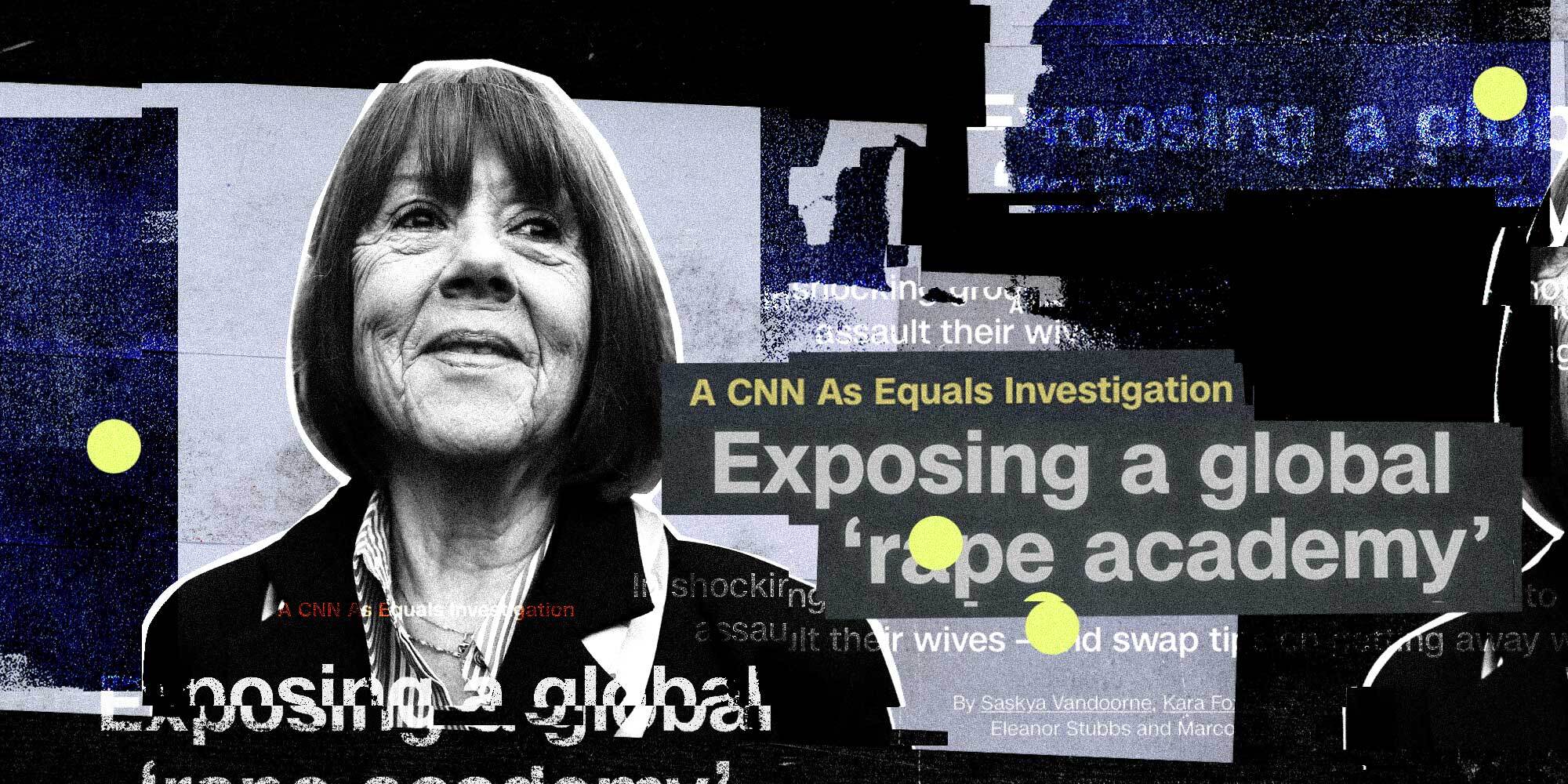
A CNN investigation into online sexual exploitation documented cases where individuals were abused, recorded, and later discovered that the footage had been shared online—sometimes viewed thousands or even millions of times without their knowledge.Cable News Network (CNN). (2026). Expose: Rape, assault, and the internet. https://www.cnn.com/interactive/2026/03/world/expose-rape-assault-online-vis-intl/index.htmlCopy
For many, the moment of discovery became a second trauma.
One survivor described it as “being violated all over again,” realizing that strangers were continuing to watch something they never consented to.
Another explained how the harm didn’t stop with the initial abuse: “It doesn’t end when the assault ends. It keeps happening every time someone watches it.”
In some cases, victims were unconscious. In others, they were coerced, manipulated, or recorded without their knowledge. But the outcome was the same: their experiences became content.
Content that could be uploaded, shared, and monetized.
These accounts reveal a consistent reality: digital distribution extends abuse far beyond the original act.

Exploitation in Training
CNN’s reporting also highlighted how some online spaces normalize voyeurism and nonconsensual scenarios, allowing exploitation to be reframed as entertainment and shared widely.
In Gisèle’s case, her husband posted on online forums that promote sexual violence advertising.
He solicited “abusers” on a dating app, then moved the conversation to Skype, providing instructions and rules. He sent photos, videos, and live streams of his wife sleeping to entice participants.
He also shared pornographic images and videos of her being raped.
One man interested in participating said, “I don’t know how you do this, but I dream of doing the same to my wife.”
The website he initially used was filled with messages of men sharing nonconsensual pornographic images and videos of their partners being abused.
A form of porn exchange where men share images of their wives with strangers, transforming real relationships into content and stripping away the humanity of those closest to them.
As CNN dove deeper, they found entire communities existing to create and train people on “sleep porn”, teaching others how to get away with it.
“How much are you willing to pay to watch my F**k, my wife while she sleeps,” one user asks.
The Rise of “Sleep Porn”
Similar to the type of content made of Gisèle, “sleep porn” refers to content where a person appears unconscious or unable to respond while being sexually violated on camera.
While it may sound like a fringe category, reporting suggests it is far more widespread than many realize.
Investigations have uncovered thousands of posts, videos, and discussions across platforms dedicated to this type of content, with some individual videos reaching tens of thousands—and in some cases, far more—views. The scale is difficult to fully measure, in part because content is frequently reuploaded, renamed, or moved across sites faster than it can be removed.
So why does this content attract an audience?
Part of the appeal appears to center on control and voyeurism. Research shows that some consumers are drawn to scenarios that emphasize dominance, passivity, or the removal of resistance, dynamics that can be exaggerated in certain types of explicit content.Malamuth, N. M., Addison, T., & Koss, M. (2000). Pornography and sexual aggression: Are there reliable effects and can we understand them? Annual Review of Sex Research, 11(1), 26–91Copy In these scenarios, the lack of response is framed as part of the fantasy, even though in reality it represents an inability to consent.
Another factor is perceived anonymity.
Digital platforms can create environments where users feel distanced from the real people involved, making it easier to engage with content without fully confronting its human impact. Studies on online behavior have found that anonymity can reduce accountability and increase the likelihood of engaging with harmful or exploitative material.Suler, J. (2004). The online disinhibition effect. CyberPsychology & Behavior, 7(3), 321–326. https://doi.org/10.1089/1094931041291295Copy
Despite the clear risks and documented harm, this content often remains online.
One reason is the challenge of moderation at scale. Major platforms host massive volumes of user-uploaded content, and don’t have the infrastructure in place to properly identify nonconsensual material. Even when the content does get removed, it is frequently reuploaded or shared on other platforms, creating a cycle that allows it to persist.
Legal gaps also play a role. Laws addressing nonconsensual imagery vary widely by region, and enforcement can be slow, particularly when content crosses international borders. Survivors are often left navigating complex reporting systems while the material continues to circulate.
The result is a category of content that is difficult to track, difficult to remove, and, for those affected, difficult to escape.

The Survivors
Gisèle had no idea about the rape, the images, the men. But she’s not alone.
CNN’s investigation found more women who endured the same exploitation in various conversations. Their piece sparked not only online outrage and shock from many, but also sparked more conversations with other victims on Reddit.
“I’m 100% certain my ex did this to me… I need people to talk with because I feel like I’m going insane.” – Thinkingavacado
“I’m in the same boat, thought I was losing my grasp on reality. . .” -Fit-Nectarine
“My ex-husband did this to me in 2019. . . I’m not sure I want to know if I’m one of the women who’s in the video bank, because I’m not confident s**t would be done about it”- CapnAnonymouse
“Same!… I would wake up with pajamas on backward, memory of bright flashing lights, internal pain, and bruises that I couldn’t explain. . . “ – RuaDC
The overlap between these real-world cases and certain forms of pornography is difficult to ignore.
The content, often referred to as “sleep porn,” portrays individuals who appear unconscious or unable to respond, framing passivity as part of the scenario. Analyses of popular pornography show that 33% to 88% of scenes include aggression or nonconsensual elements, often without clear acknowledgment of harm.Bridges, A. J., Wosnitzer, R., Scharrer, E., Sun, C., & Liberman, R. (2010). Aggression and sexual behavior in best-selling pornography videos: A content analysis update. Violence Against Women, 16(10), 1065–1085. https://doi.org/10.1177/1077801210382866Copy
Over time, repeated exposure to these exaggerated scenarios can shape expectations through the brain’s natural process of neuroplasticity, reinforcing what feels familiar or acceptable.Pace, S. (2014). Acquiring tastes through online activity: Neuroplasticity and the flow experiences of web users. M/C Journal, 17(1). https://doi.org/10.5204/mcj.773; Hilton, D. L. (2013). Pornography addiction—A supranormal stimulus considered in the context of neuroplasticity. Socioaffective Neuroscience & Psychology, 3, 20767. https://doi.org/10.3402/snp.v3i0.20767Copy
If everyday porn shows the same lack of consent, violence, and abuse, it’s not surprising that this type of content has been normalized and even recreated.
In Gisèle’s case, some perpetrators reportedly interpreted the absence of resistance as permission, a misunderstanding that reflects how deeply distorted ideas of consent can become, but how often it’s portrayed in pornography.
Survivors Speak Out
Survivors often describe a loss that goes beyond physical harm—the loss of being seen as a person.
One survivor in CNN’s investigation described feeling like she had been reduced to “something to be used, not someone to be known.”
Pornography fuels objectification and can contribute to dehumanization and reduced empathy toward others.Zhou, Y., Liu, T., Yan, Y., & Paul, B. (2021). Pornography use, dehumanization, and sexual aggression: Attitudes vs. behaviors. Journal of Sex Research. https://doi.org/10.1080/0092623X.2021.1923598Copy
In Gisèle’s experience, that dehumanization became reality, her autonomy removed, her awareness erased.
Despite the trauma, she chose to reveal her identity, leading countless survivors to join her in sharing their stories.
Gisèle has said she wants future generations to understand what happened and to confront the silence that often surrounds sexual violence.Fortune. (2026). Gisèle Pelicot: A hymn to life. https://fortune.com/2026/03/31/gisele-pelicot-a-hymn-to-life-92ny-nyc/Copy
Other survivors interviewed by CNN expressed similar motivations, hoping their stories might prevent further harm and raise awareness about exploitation.
Their voices bring visibility to experiences that are often hidden.
“I am rebuilding myself,” Gisèle said, acknowledging both the depth of the harm and the strength required to move forward.CBS News. (2026). Gisèle Pelicot speaks out after abuse case. https://www.cbsnews.com/news/gisele-pelicot-speaks/Copy
What happened to Gisèle Pelicot didn’t begin the night she was drugged.
It began long before that—in a culture where people can be reduced to content, where silence can be mistaken for consent, and where exploitation can be reframed as entertainment.
Her story forces a difficult but necessary question:
What kind of world are we helping create with what we watch, share, and normalize?
Because when real people are treated like objects, the consequences don’t stay on a screen.
They show up in our homes. Our schools. In relationships. In real lives.
Gisèle chose to speak so others wouldn’t have to suffer in silence.
The question is whether we’re willing to listen—and what we do next.
Get Help
If the accounts of sexual exploitation above resonate with experiences you’ve had, please know you are not alone. If you are looking for help with drug-related sexual assault, nonconsensual sexual imagery, or sexual abuse, please know there is help available.
Below is a list of resources that may help.
- National Sexual Assault Hotline (U.S.)
Call: 1-800-656-HOPE (4673)
Online Chat: https://rainn.org
Operated by the Rape, Abuse & Incest National Network (RAINN), this hotline offers confidential, 24/7 support from trained advocates who can help you process what happened, explore options, and connect with local resources. - RAINN (Rape, Abuse & Incest National Network)
Website: https://rainn.org
RAINN provides education, survivor support, and tools for navigating reporting, recovery, and healing after sexual violence. - National Domestic Violence Hotline
Call: 1-800-799-7233
Text: START to 88788
Website: https://www.thehotline.org
Support for individuals experiencing relationship abuse, coercion, or unsafe environments. Available 24/7 with confidential assistance. - Cyber Civil Rights Initiative (CCRI)
Website: https://cybercivilrights.org
CCRI supports survivors of nonconsensual image sharing (“revenge porn”) and provides guidance on legal options, content removal, and emotional support. - Without My Consent
Website: https://withoutmyconsent.org
Offers resources and legal information for individuals dealing with image-based abuse and privacy violations. - Support exists globally. You can find international helplines and resources here:
https://www.ibiblio.org/rcip/internl.html
Your Support Matters Now More Than Ever
Most kids today are exposed to porn by the age of 12. By the time they’re teenagers, 75% of boys and 70% of girls have already viewed itRobb, M.B., & Mann, S. (2023). Teens and pornography. San Francisco, CA: Common Sense.Copy —often before they’ve had a single healthy conversation about it.
Even more concerning: over half of boys and nearly 40% of girls believe porn is a realistic depiction of sexMartellozzo, E., Monaghan, A., Adler, J. R., Davidson, J., Leyva, R., & Horvath, M. A. H. (2016). “I wasn’t sure it was normal to watch it”: A quantitative and qualitative examination of the impact of online pornography on the values, attitudes, beliefs and behaviours of children and young people. Middlesex University, NSPCC, & Office of the Children’s Commissioner.Copy . And among teens who have seen porn, more than 79% of teens use it to learn how to have sexRobb, M.B., & Mann, S. (2023). Teens and pornography. San Francisco, CA: Common Sense.Copy . That means millions of young people are getting sex ed from violent, degrading content, which becomes their baseline understanding of intimacy. Out of the most popular porn, 33%-88% of videos contain physical aggression and nonconsensual violence-related themesFritz, N., Malic, V., Paul, B., & Zhou, Y. (2020). A descriptive analysis of the types, targets, and relative frequency of aggression in mainstream pornography. Archives of Sexual Behavior, 49(8), 3041-3053. doi:10.1007/s10508-020-01773-0Copy Bridges et al., 2010, “Aggression and Sexual Behavior in Best-Selling Pornography Videos: A Content Analysis,” Violence Against Women.Copy .
From increasing rates of loneliness, depression, and self-doubt, to distorted views of sex, reduced relationship satisfaction, and riskier sexual behavior among teens, porn is impacting individuals, relationships, and society worldwideFight the New Drug. (2024, May). Get the Facts (Series of web articles). Fight the New Drug.Copy .
This is why Fight the New Drug exists—but we can’t do it without you.
Your donation directly fuels the creation of new educational resources, including our awareness-raising videos, podcasts, research-driven articles, engaging school presentations, and digital tools that reach youth where they are: online and in school. It equips individuals, parents, educators, and youth with trustworthy resources to start the conversation.
Will you join us? We’re grateful for whatever you can give—but a recurring donation makes the biggest difference. Every dollar directly supports our vital work, and every individual we reach decreases sexual exploitation. Let’s fight for real love: