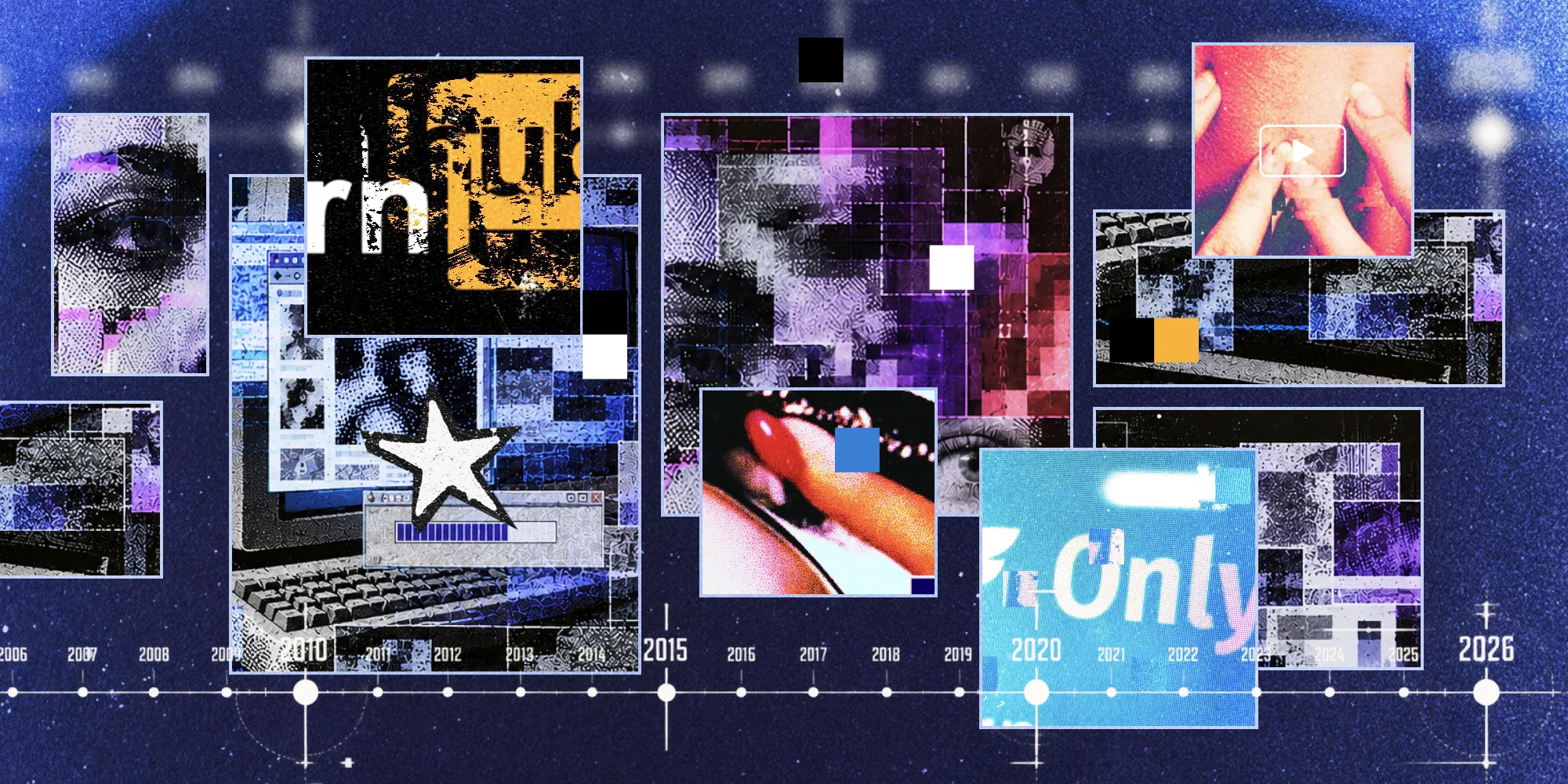
Ten years ago, the phrase “internet porn” probably brought a fairly specific image to mind: someone opening an incognito browser, typing the name of a major porn site, and scrolling through thousands of videos.
That version of pornography hasn’t disappeared. Pornhub and other tube sites still attract enormous audiences. But today, porn can begin with an Instagram profile and end behind a subscription paywall. It can involve private messages with a creator, livestreams, custom requests, or an AI-generated video that never happened in real life. Explicit content can circulate through X, Reddit, Telegram, and other platforms, while algorithms, search engines, affiliate links, and mainstream social media can direct people toward it.
At the same time, the content itself keeps evolving. Pornography platforms compete for attention in an internet saturated with sexual content, where novelty, personalization, and increasingly attention-grabbing material can become powerful commercial advantages.
And behind all that technological change remains whether or not the person on the other side of the screen consented, if the porn we’re seeing today is impacting their mental health, relationships, and changing the culture around us.
If you think porn is still just Pornhub, you’re missing what’s happening.
Porn Used to Be Somewhere You Went. Now It Can Be Woven Into the Internet Around You.
Pornography has always adapted to new technology. Print gave way to film and video, video gave way to the internet, and paid adult websites eventually faced competition from massive free “tube” sites.
That transition radically expanded access. Instead of buying a magazine, renting a video, or paying for individual websites, consumers could suddenly browse enormous libraries of explicit videos within seconds.
But the next transformation has been less about creating one bigger porn site and more about distributing pornography throughout the wider digital ecosystem.
Mainstream social platforms can function as marketing funnels for paid explicit content. Creators build audiences through ordinary influencer strategies, then direct followers toward subscription platforms. Reddit communities and social platforms can circulate explicit clips and links. Messaging platforms can host private channels. Search engines make virtually every category imaginable immediately discoverable.
OnlyFans pushed that convergence even further. The platform combines elements of pornography, social media, influencer culture, subscription entertainment, and direct messaging. Instead of simply watching a performer, subscribers may follow the creator’s everyday posts, pay for private interactions, request customized material, and feel as though they know the person producing it.
Porn didn’t simply become easier to access. The boundary separating pornography from the rest of online life became less obvious.
There Is More Porn, in More Formats, Available More Quickly Than Ever
The sheer scale of choice has also changed the experience.
Traditional pornography required physical production and distribution. Even early internet pornography remained constrained by bandwidth, storage, production costs, and relatively limited catalogs.
Those constraints have largely disappeared.
A consumer can move between professionally produced videos, amateur uploads, livestreams, subscription content, animated pornography, interactive material, virtual reality, custom videos, and increasingly AI-generated sexual content without leaving a phone.
Pornhub’s own 2025 platform data illustrates how broad contemporary porn consumption has become. Its most-searched terms included hentai, MILF, and Pinay, while its most-viewed categories included lesbian, transgender, MILF, anal, mature, Japanese, threesome, hentai, and other categories. The data reflects activity on one platform used by millions. It offers a window into the enormous variety that major platforms organize, recommend, and make searchable, in which some categories fetishize racial and gender stereotypes.Pornhub. (2025). 2025 Year in Review. Pornhub Insights. https://www.pornhub.com/insights/2025-year-in-reviewCopy
That variety has consequences for how pornography gets consumed. Instead of encountering a limited selection, someone can search for a particular body type, age fantasy, ethnicity, sexual act, relationship scenario, fetish, character, animation style, or increasingly specific combination of preferences.
And if the existing catalog doesn’t provide exactly what someone wants, newer technologies increasingly allow consumers to request or generate it.
The Competition for Attention Can Reward Novelty and Escalation
Pornography exists inside the same attention economy as TikTok, YouTube, Instagram, gaming, streaming entertainment, and virtually every other digital product competing for people’s time.
But pornography has a unique advantage in that competition: sexual novelty itself can capture attention.
Platforms can offer endless new performers, scenes, categories, thumbnails, fantasies, and recommendations. A consumer doesn’t need to wait for the next movie or magazine issue. They can move from one stimulus to another almost instantly.
That environment can also affect what gets produced.
Porn performers have publicly described pressure to participate in acts they found painful, degrading, or outside what they originally expected. These accounts don’t establish that every performer has the same experience, and individual testimony shouldn’t be generalized to an entire industry. They do reveal something consumers cannot determine from the finished product: a scene can look consensual on-screen while the circumstances surrounding its production are far more complicated.
Former performers have reported enduring physical pain, pressure, degradation, producers continuing despite distress, and experiences they later characterized as abusive.
A video can become extremely popular without viewers knowing what occurred immediately before the camera started recording, what happened between takes, or how the performer felt afterward.
OnlyFans Creates a New Level of Porn
One of the biggest changes of the past decade involves who seems to hold the camera—and who appears to hold the power.
Traditional commercial pornography generally involved recognizable studios, producers, directors, distributors, and performers. Creator platforms promised something different: individuals could produce their own material, communicate directly with subscribers, set prices, and keep more control over their businesses.
For some creators, that distinction is genuine. Many operate independently and describe choosing their own boundaries and content.
But the creator economy has also developed its own middlemen.
Recent investigations have examined the growth of OnlyFans management agencies, businesses that recruit creators and offer to manage promotion, pricing, subscriber communication, and other aspects of their accounts. Some provide ordinary business services. Other former creators have alleged manipulative recruitment, financial pressure, loss of account control, and pressure to produce increasingly explicit material.
The Guardian reported in 2026 that some women said agencies took substantial portions of their earnings and pushed them toward more explicit content. The reporting also described the use of “chatters”—workers who communicate with subscribers while posing as the creator, turning what may feel like intimate one-on-one communication into a managed sales strategy.Das, S. (2026, June 18). The malignant rise of OnlyFans managers: 'It's exploiting. It's grooming. It's predatory'. The Guardian. https://www.theguardian.com/society/2026/jun/18/malignant-rise-onlyfans-managers-exploiting-grooming-predatoryCopy
That doesn’t mean every agency exploits creators or every creator lacks control. It does complicate one of the most common assumptions about creator pornography: that removing traditional studios automatically removes third-party pressure.
The middlemen didn’t necessarily disappear. In some cases, they changed form.
Personalized Porn Has Changed What Consumers Are Buying
Traditional porn primarily sold access to content. Subscription platforms can sell something more psychologically complicated: access to a person.
Subscribers may pay for private messages, custom content, livestreams, personalized requests, or interactions that appear to come directly from a particular creator. That creates a different consumer experience from anonymously selecting a prerecorded video.
Someone can follow a creator’s social media, learn details about their everyday life, subscribe to their explicit content, exchange messages, send tips, request personalized material, and receive responses addressed specifically to them.
Those features can strengthen parasocial attachment—the feeling of knowing or having a relationship with a media figure who doesn’t share the same reciprocal relationship.
The product has expanded from “watch this sexual content” toward something closer to “purchase personalized sexual attention.” And even that personalization is evolving again as generative AI makes customized sexual content possible without requiring a human performer to create each request.
AI Porn
For most of pornography’s history, creating a pornographic image required photographing or filming something. Generative AI has broken that relationship between image and event.
AI tools can create synthetic sexual images, alter existing photographs, swap faces, generate video, and place real people’s likenesses into sexual scenarios they never participated in.
The Institute for Strategic Dialogue documented just how established this ecosystem had become by 2026. Researchers identified 181 publicly accessible “nudify” websites that allowed users to transform photographs of real people into sexualized or pornographic material. ISD estimated that these websites collectively received more than 40 million unique visitors per month between December 2025 and March 2026.Institute for Strategic Dialogue. (2026, July 13). Mapping the 'Nudify' Tools Ecosystem. https://www.isdglobal.org/publication/mapping-the-nudify-tools-ecosystem/Copy
The tools weren’t hidden exclusively on obscure forums. ISD found an ecosystem connected to mainstream search engines, social media, messaging services, payment systems, app stores, hosting infrastructure, and affiliate marketing.
Some services were offered for free for generations before charging for additional images. Others advertised face swaps, customized scenarios, sexualized video generation, or longer AI-generated content.
Pornography is becoming programmable.
A consumer increasingly doesn’t have to search for a scene that matches a fantasy. Technology can manufacture one. That development creates an enormous consent problem because the person whose face or body appears in the resulting content may never have consented to sexual content at all.
Abuse and Exploitation Haven’t Disappeared With the Old Porn Industry
New technology can make pornography look cleaner, more independent, and more user-controlled. But technology doesn’t automatically eliminate exploitation. One of the clearest examples comes from GirlsDoPorn, a pornography company whose videos accumulated enormous online audiences.
Federal prosecutors said the operation recruited women through deceptive advertisements for modeling jobs and falsely assured many that the videos would not appear online. Prosecutors described a system involving fraud, coercion, threats, and sexual exploitation.
In September 2025, a federal judge sentenced GirlsDoPorn owner Michael Pratt to 27 years in prison. The U.S. Department of Justice said Pratt had orchestrated a scheme that deceived and exploited hundreds of women.
The case exposes a problem that pornography consumers cannot solve simply by examining what appears on-screen.
You cannot reliably see consent in a finished video.
A viewer doesn’t know whether someone received accurate information before arriving on set. They don’t know what was negotiated, whether boundaries changed, whether someone felt free to stop, whether threats or financial pressure occurred, or whether everyone consented to the video’s eventual distribution.
Consent to one sexual act doesn’t automatically mean consent to another. Consent to being recorded doesn’t automatically mean consent to worldwide distribution. And appearing to participate on camera cannot tell a stranger everything that happened behind it.
Trafficking Can Exist Alongside Commercial Pornography
Sex trafficking and pornography aren’t interchangeable terms. It would be inaccurate and unfair to suggest that everyone performing in pornography is trafficked. But pornography can become a vehicle through which traffickers exploit victims and monetize sexual abuse.
The GirlsDoPorn prosecutions provide a documented example of federal sex-trafficking convictions connected directly to commercial pornography. More recent investigations into online creator agencies have raised similar concerns about how control over accounts, earnings, content, and recruitment can become tools for exploitation.
In June 2026, Journalismfund Europe reported that a cross-border journalistic investigation into OnlyFans management agencies had been followed by arrests and human-trafficking charges in the Czech Republic. The underlying reporting documented allegations from women who described predatory recruitment, emotional manipulation, pressure to create increasingly explicit content, lost account access, unpaid earnings, and restrictive contracts.
They demonstrate why “independent,” “amateur,” or “creator-controlled” shouldn’t function as automatic guarantees of ethical production. The consumer still sees a screen. The circumstances behind it can remain invisible.
“Amateur” Doesn’t Automatically Mean Ethical Either
The popularity of amateur-style pornography creates another complication. Content marketed as amateur can appear more authentic precisely because it looks less professionally produced. Consumers may interpret that aesthetic as evidence that ordinary people enthusiastically created and uploaded it themselves.
But appearance tells us very little about consent or distribution.
An intimate recording can begin consensually and later get uploaded without someone’s permission. A partner can use sexual images as a form of control or retaliation. Someone can secretly record another person. Traffickers can produce material that resembles independent content. Commercial studios can deliberately imitate an amateur aesthetic.
AI makes that uncertainty even greater because a realistic-looking “person” may be partly or completely synthetic—or a real person’s likeness may have been used without consent.
The old distinction between “professional porn” and “amateur porn” no longer tells consumers enough about how a piece of content came into existence.
The Porn People Watch Has Changed Alongside How They Watch It
The technological transformation gets much of the attention, but the content itself deserves scrutiny.
Pornhub’s platform data shows huge audiences distributed across categories built around particular bodies, identities, acts, relationship scenarios, animation, and fantasies. Hentai remained the site’s most-searched term globally in its 2025 review, while categories such as lesbian, transgender, MILF, anal, mature, Japanese, threesome, and hentai ranked among its most viewed.
Pornography platforms measure behavior inside pornography platforms, where recommendations, thumbnails, novelty, available content, cultural trends, and the site’s own categorization systems can all influence what people click.
Still, the trends reveal how far pornography has moved from a limited catalog.
A user can now navigate thousands of highly specific categories and continually refine what they want to see. Animated pornography removes some physical limits entirely. Creator platforms add customization. AI takes personalization even further.
Meanwhile, former performers have described how demand for attention-grabbing and aggressive material can translate into difficult conditions behind the scenes. We’ve previously shared performers’ accounts of scenes involving pain, degradation, pressure, and boundaries they felt producers or other performers failed to respect.
Those stories are testimony rather than population-level research, so they cannot tell us how frequently every kind of mistreatment occurs. But they expose the disconnect between a category label or thumbnail and the human experience required to produce the content.
Mainstream Porn Can Help Turn Once-Fringe Behaviors Into Sexual Expectations
Porn platforms organize people into searchable products. The person inside the product still has boundaries, health, relationships, vulnerabilities, and a life outside the frame. Porn hasn’t only changed in where people find it or how personalized it has become. The sexual behaviors portrayed in mainstream pornography have changed too—and some practices that were once considered relatively niche now appear far more culturally familiar.
Sexual choking is one of the clearest examples.
Although people commonly call it “choking,” applying pressure to another person’s neck is technically a form of strangulation. Researchers have documented how sexual choking has become increasingly common among young adults and increasingly represented as a normal part of sex in pornography, social media, memes, and popular culture.
A major 2023 study examined the relationship between pornography consumption and sexual choking among heterosexual-identified college men. Researchers found a sequential pattern: more frequent pornography consumption was associated with greater exposure to pornographic depictions of choking, which was in turn associated with a greater likelihood of choking sexual partners through beliefs that choking was pleasurable, safe, and did not require consent from the person being choked.Wright, P. J., Herbenick, D., & Tokunaga, R. S. (2023). Pornography consumption and sexual choking: An evaluation of theoretical mechanisms. Health Communication, 38(6), 1099–1110. https://doi.org/10.1080/10410236.2021.1991641Copy
The researchers did not conclude that pornography single-handedly causes someone to strangle a partner. Sexual behavior develops through many influences, including partners, peers, social media, personal preferences, and broader cultural norms. But the study supports something researchers call sexual scripting: media can help teach people which behaviors belong in sex, what those behaviors supposedly mean, and what responses people should expect from a partner.
Another study examining heterosexual-identified college women found that greater pornography use predicted greater exposure to depictions of choking in pornography. That exposure was associated with women’s eroticization of choking and, in turn, with a greater likelihood of having been choked by male partners.Wright, P. J., Herbenick, D., & Tokunaga, R. S. (2022). Pornography and women’s experience of mixed-gender sexual choking/strangulation: Eroticization mediates, perceived similarity moderates. Journal of Health Communication, 27(3), 173–182. https://doi.org/10.1080/10810730.2022.2073406Copy
The cultural shift can become self-reinforcing. Porn depicts choking as ordinary sexual behavior. Consumers encounter it repeatedly. Social media turns it into jokes, memes, and shorthand for passionate sex. Partners begin expecting it. Eventually, something that once appeared relatively extreme can start feeling routine.
Researchers studying sexual choking in Australia have found exactly this kind of normalization. Their review of the existing evidence noted that pornography frequently presents choking as pleasurable and relatively consequence-free while minimizing or omitting its potential harms.
And those harms are not hypothetical.
Pressure on the neck can interfere with blood flow to and from the brain, restrict airflow, or both. Research involving university students who had experienced sexual choking found reported responses including difficulty breathing and swallowing, inability to speak, bruising, and loss of consciousness. A 2026 medical review described sexual strangulation as physiologically unpredictable and warned that it can cause unconsciousness, brain injury, and death.Kero, K., Wahlsten, P., & Lauerma, H. (2026). “And then I got strangled”: Dangerous trends of sexual choking among young people. Acta Obstetricia et Gynecologica Scandinavica. https://doi.org/10.1111/aogs.70193Copy
Yet mainstream sexual media rarely pauses a scene to explain vascular anatomy, neurological injury, or whether the people involved explicitly negotiated what would happen.
The viewer sees the sexual script, not the medical risk.
Choking isn’t the only behavior worth examining. Mainstream pornography routinely organizes content around rough sex, domination, humiliation, aggression, and increasingly specific acts and fantasies. Research examining popular pornographic videos has repeatedly found physical aggression in a substantial portion of mainstream content, although prevalence estimates vary considerably depending on researchers’ definitions, samples, platforms, and methods.
That variability deserves attention. It would be inaccurate to claim that every mainstream porn scene is violent or that everyone who watches aggressive pornography will imitate it. But it is equally inaccurate to treat porn as culturally neutral entertainment that simply reflects sexual preferences without potentially helping shape them.
Pornography can provide consumers with scripts about what sex looks like: which behaviors are normal, what bodies should tolerate, how partners supposedly respond to aggression, and what someone may be expected to enjoy.
Over time, repetition can change the reference point.
A practice doesn’t have to appear in every porn video to become culturally normalized. It only has to become familiar enough that people stop experiencing it as unusual.
That may be one of the most consequential ways pornography has changed in the past decade. The question is no longer only whether increasingly intense content is available.
It’s whether repeated exposure can gradually redefine what people think ordinary sex is supposed to look like.
The Central Question Has Shifted From “Where Is the Porn?” to “Where Isn’t It?”
The biggest change in pornography over the past decade may not be one platform, one category, or one technology.
It’s convergence.
Pornography has converged with social media through creator promotion and influencer culture. It has converged with subscription services through OnlyFans-style platforms. It has converged with livestreaming and private messaging. Virtual reality has made content more immersive. Generative AI can make it synthetic and infinitely customizable. Search engines and recommendation systems make increasingly specific material discoverable almost instantly.
At the same time, old problems haven’t vanished. Performers can still experience abuse. Producers and partners can still violate boundaries. Intimate material can still circulate without consent. Traffickers can still monetize victims. Consumers can still have little idea what happened behind a video before they clicked it.
And AI has introduced an entirely new category of victim: someone who never participated in pornography at all. Ten years ago, educating someone about internet pornography could focus heavily on porn websites.
That framework is no longer enough.
Pornography now exists within an ecosystem of platforms, creators, algorithms, payment processors, artificial intelligence, social media, private messages, recommendation systems, and massive searchable libraries. Understanding it requires more than asking whether someone visits Pornhub.
It requires asking what kind of content they’re consuming, how they found it, who profits from it, what algorithms are encouraging next, whether the people depicted meaningfully consented to its creation and distribution, and whether the intimacy or authenticity being sold is actually what it appears to be.
Technology has transformed pornography at an extraordinary speed.
Human dignity hasn’t changed with it. Consent still requires freedom. Exploitation doesn’t become ethical because it happens through an app. A person doesn’t become a product simply because a platform can place a price tag on their image.
And authentic intimacy still asks something pornography cannot provide on demand: two people who can see each other as whole human beings, respect each other’s boundaries, communicate honestly, and freely choose one another.
Your Support Matters Now More Than Ever
Most kids today are exposed to porn by the age of 12. By the time they’re teenagers, 75% of boys and 70% of girls have already viewed itRobb, M.B., & Mann, S. (2023). Teens and pornography. San Francisco, CA: Common Sense.Copy —often before they’ve had a single healthy conversation about it.
Even more concerning: over half of boys and nearly 40% of girls believe porn is a realistic depiction of sexMartellozzo, E., Monaghan, A., Adler, J. R., Davidson, J., Leyva, R., & Horvath, M. A. H. (2016). “I wasn’t sure it was normal to watch it”: A quantitative and qualitative examination of the impact of online pornography on the values, attitudes, beliefs and behaviours of children and young people. Middlesex University, NSPCC, & Office of the Children’s Commissioner.Copy . And among teens who have seen porn, more than 79% of teens use it to learn how to have sexRobb, M.B., & Mann, S. (2023). Teens and pornography. San Francisco, CA: Common Sense.Copy . That means millions of young people are getting sex ed from violent, degrading content, which becomes their baseline understanding of intimacy. Out of the most popular porn, 33%-88% of videos contain physical aggression and nonconsensual violence-related themesFritz, N., Malic, V., Paul, B., & Zhou, Y. (2020). A descriptive analysis of the types, targets, and relative frequency of aggression in mainstream pornography. Archives of Sexual Behavior, 49(8), 3041-3053. doi:10.1007/s10508-020-01773-0Copy Bridges et al., 2010, “Aggression and Sexual Behavior in Best-Selling Pornography Videos: A Content Analysis,” Violence Against Women.Copy .
From increasing rates of loneliness, depression, and self-doubt, to distorted views of sex, reduced relationship satisfaction, and riskier sexual behavior among teens, porn is impacting individuals, relationships, and society worldwideFight the New Drug. (2024, May). Get the Facts (Series of web articles). Fight the New Drug.Copy .
This is why Fight the New Drug exists—but we can’t do it without you.
Your donation directly fuels the creation of new educational resources, including our awareness-raising videos, podcasts, research-driven articles, engaging school presentations, and digital tools that reach youth where they are: online and in school. It equips individuals, parents, educators, and youth with trustworthy resources to start the conversation.
Will you join us? We’re grateful for whatever you can give—but a recurring donation makes the biggest difference. Every dollar directly supports our vital work, and every individual we reach decreases sexual exploitation. Let’s fight for real love: