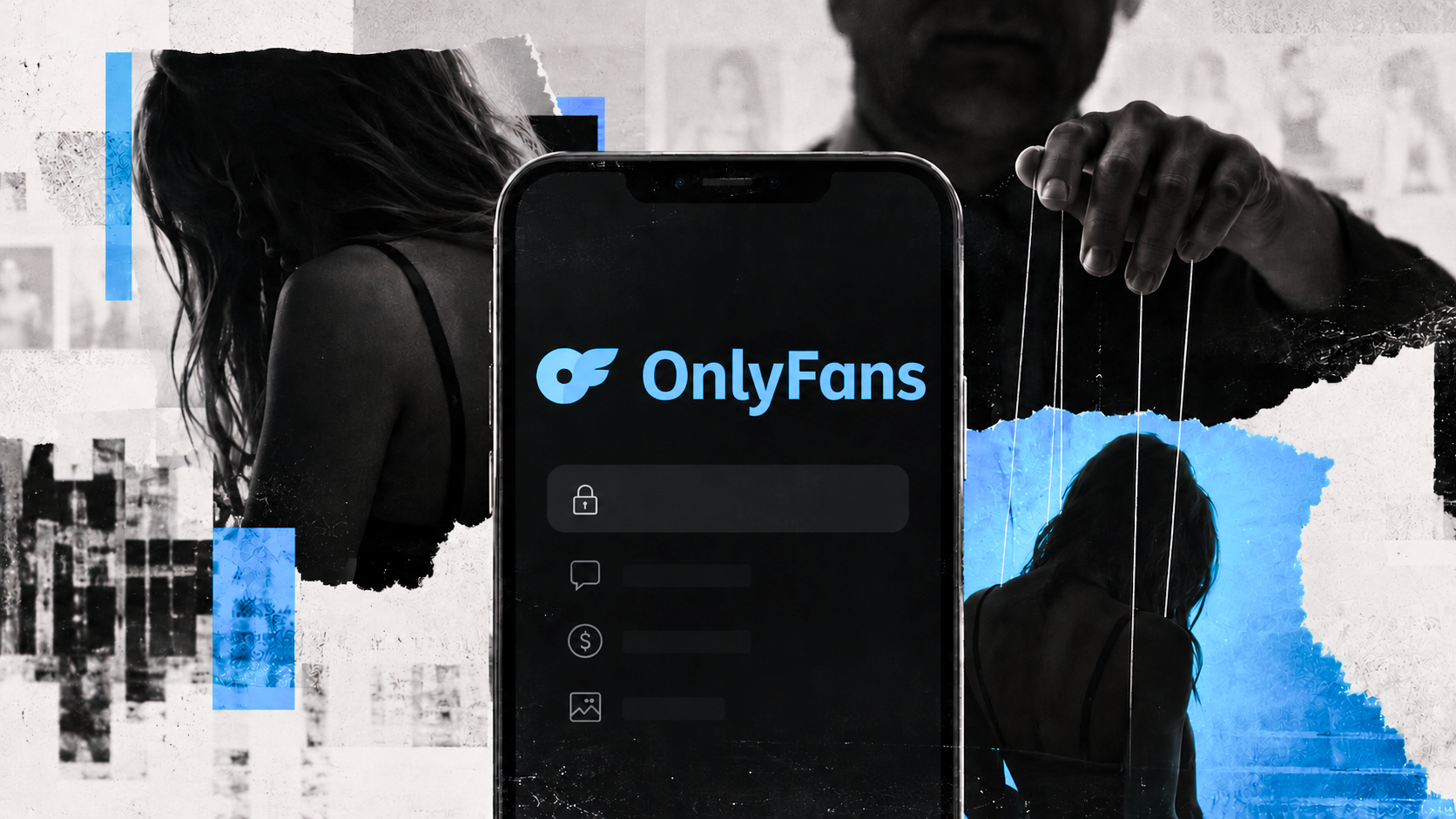
OnlyFans is often presented as a “more ethical” alternative to traditional pornography because it’s creator or performer-focused versus traditional mainstream pornography. Creators make their own content, control their own accounts, set their own boundaries, and get paid directly. There is no production studio, director, or producer controlling elements of the scene. All of that makes it seem there is less opportunity for exploitation or abuse.
But what if the person appearing on screen as the “creator” actually isn’t actually the person in control? Two recent criminal cases in the United Kingdom offer a disturbing answer.
In one case, a man secretly captured intimate images of a woman and sold them through OnlyFans without her knowledge. In another case, a man isolated a woman from family and friends, pressured her to create an OnlyFans account, controlled the account from his phone, and pushed her to produce increasingly explicit material.
These cases were different. But both expose the same problem: just seeing someone appear in sexual content does not tell you whether they freely chose to be there. And as domestic abuse organizations, journalists, and anti-trafficking experts increasingly warn, coercion can exist behind a screen even when an account appears legitimate.
Two UK Cases Expose Two Different Forms of Nonconsensual Pornography
In August 2026, The Guardian reported on two separate criminal cases involving explicit material posted to OnlyFans without the full consent of the women depicted.
In the first case, 37-year-old Alexander Tang secretly captured intimate images and videos of a woman. According to Northumbria Police, the woman discovered something was wrong after men contacted her, claiming they had spoken with her through social media and dating apps. She found fake profiles containing photographs of herself that she had never knowingly provided.
Some of the images were intimate. Eventually, she discovered that Tang had captured them using hidden cameras and that images of her had appeared across multiple websites, including OnlyFans.
Police said Tang uploaded 47 intimate images and four videos to OnlyFans and received money from the material. He had even photographed the woman’s identification and used it to help legitimize the account. Tang pleaded guilty to voyeurism and received a 26-week suspended prison sentence. His victim described the lasting impact of knowing strangers had seen, shared, and commented on intimate images she never agreed to distribute.
The second case involved another form of coercion.
During the trial of 43-year-old Dean Holmes, Bolton Crown Court heard that Holmes isolated a woman from her family and friends and pressured her to create an OnlyFans account to make money.
According to The Guardian, Holmes set up the account in her name but operated it from his phone. The woman initially uploaded bikini photographs, but prosecutors said Holmes pressured her to post increasingly explicit content while he communicated with paying subscribers through the account. Holmes pleaded guilty to assault and controlling and coercive behavior and was convicted of rape following a trial.
Neither case was reported as a trafficking conviction. But both demonstrate that an account can look consensual to the consumer while abuse is happening completely outside the consumer’s view.
Consent to One Thing Isn’t Consent to Everything
The cases also demonstrate why consent cannot be reduced to whether someone appeared in an image, created an account, or participated at some point. Consent is specific. Agreeing to take one photograph doesn’t mean agreeing to have someone sell it. Agreeing to post a bikini photo doesn’t mean agreeing to post increasingly explicit material. Agreeing to create an account doesn’t give another person permission to control it. And consenting once does not eliminate someone’s right to establish boundaries later.
In Tang’s case, the woman didn’t even know the intimate images had been captured.
In the Holmes case, the court heard that the woman initially participated in creating content, but that Holmes pressured her into increasingly explicit material while controlling the account himself. This is one reason coercion can be difficult for outsiders to recognize.
Someone experiencing coercive control may still appear to make choices. They may take photographs, record videos, respond to messages, or remain in a relationship with the person exploiting them.
But visible participation doesn’t tell us what threats, manipulation, financial control, isolation, or violence may exist outside the frame.
Domestic Abuse Organizations Say These Cases Aren’t Isolated
The two convictions arrived amid broader warnings about technology-facilitated abuse.
According to The Guardian, Women’s Aid reported in 2026 that a particularly common emerging form of tech-facilitated abuse encountered by frontline workers involved young women being coerced into opening OnlyFans accounts to generate money for abusive partners.
The Revenge Porn Helpline similarly told the newspaper that it had received reports involving women pressured into creating content for OnlyFans and similar platforms. Refuge, one of the UK’s largest domestic abuse organizations, also said its staff had supported survivors in cases involving perpetrators weaponizing OnlyFans.
This changes how we should think about online sexual exploitation. The abusive partner doesn’t necessarily need to stand behind a camera in a traditional pornography studio.
OnlyFans Managers Have Raised Even More Concerns About Coercion
These cases also come shortly after another investigation raised questions about third-party control of OnlyFans creators. In June, a BBC investigation examined the rapidly growing world of so-called OnlyFans managers, or OFMs.
These agencies and individuals promise to help creators increase their earnings by handling marketing, subscriber conversations, pricing, and account management. Some may provide ordinary business services.
Others have faced far more serious allegations. The BBC spoke with 60 UK OnlyFans creators and gained access to a private Telegram community for OnlyFans managers with approximately 24,000 members. Its investigation documented allegations of intimidation, account control, financial exploitation, pressure to produce more explicit content, and violence.
One creator told the BBC that an agency initially promised to increase her earnings. She later alleged that managers became controlling, threatened her and her daughter, and that masked attackers ultimately came to her home and assaulted her.
The investigation also found managers discussing methods for taking control of creators’ accounts and earnings. One participant reportedly described a coercive approach as the “pimp method.” Following the investigation, Independent Anti-Slavery Commissioner Eleanor Lyons and MP Tonia Antoniazzi called for a parliamentary inquiry into exploitation connected with OnlyFans.
They specifically raised concerns about indicators of trafficking, coercive control, sexual exploitation, financial control, and violence.
Trafficking Doesn’t Always Look Like Kidnapping
When many people hear the words sex trafficking, they imagine kidnapping, physical confinement, or someone being transported across borders. Those things can happen. But trafficking can also involve coercion that is much less visible.
Threats. Manipulation. Financial control. Fraud. Intimidation. Isolation. An abusive partner taking someone’s earnings or controlling the circumstances in which commercial sexual activity occurs. That’s particularly important in a digital environment.
Someone doesn’t necessarily need to physically transport another person anywhere to commercially exploit them. An exploiter can potentially control sexual content, customer interactions, money, and accounts from a phone.
The UK’s Independent Anti-Slavery Commissioner has been examining precisely this changing landscape. In February 2026, Commissioner Eleanor Lyons published Behind the Profile: Sexual Exploitation and Trafficking through Adult Services Websites, a survivor-informed investigation into online platforms used in the commercial sex market. Researchers analyzed nearly 63,000 listings across 12 adult services websites. They found that 59% of the advertisements contained three or more indicators associated with exploitation and trafficking.
The report did not establish that 59% of advertisements represented confirmed trafficking victims. Indicators flag potential exploitation; they do not independently prove a trafficking offense. But the scale of those indicators concerned researchers.
Survivors told the commission about perpetrators grooming and controlling women, creating profiles without their knowledge, arranging transactions, and collecting profits.
Some women, the report noted, initially felt in control of their involvement but experienced increasing exploitation over time. One survivor summarized the central problem with a simple question: How can anyone looking at a screen know whether the woman behind it is being coerced?
For consumers, the answer is uncomfortable. They can’t.

“Creator-Controlled” Porn Can Still Have Someone Else Behind the Controls
Part of OnlyFans’ reputation comes from the idea that it removed the traditional pornography industry’s middlemen. Instead of a studio hiring performers, creators could theoretically decide what to produce, upload it themselves, communicate directly with subscribers, and collect most of the revenue.
For some creators, that distinction may genuinely provide more independence. But independence as a business model doesn’t guarantee freedom from exploitation. The recent cases demonstrate several ways control can move away from the person appearing on screen. An abusive partner can pressure someone to open an account, manage it, and take most of the profits for themselves.
Or, as the Tang case demonstrates, someone can potentially manipulate verification procedures to monetize sexual imagery the victim never knew existed.
OnlyFans told The Guardian that it has a zero-tolerance policy for illegal content and uses strict onboarding, payment controls, and ongoing moderation. The company said it works with law enforcement and pointed to its role in supporting investigations.
We’re glad they say they have a zero-tolerance policy, but these cases demonstrate a fundamental challenge facing any platform attempting to verify consent remotely.
Identity verification and consent verification aren’t necessarily the same thing.
A platform may establish whose identification was submitted or whose face appears in an image. Determining whether that person is acting freely, whether an abusive partner controls the phone, whether someone has threatened them, or whether they genuinely agreed to a particular piece of content can be much harder, especially in the sexual exploitation space.
Pornography behind a subscription can feel different from pornography on a conventional tube site. It feels more independently created. Subscribers may believe they know who produced the material and how. Money may appear to flow directly to the person on screen. But a paywall cannot tell a consumer what happened before the content appeared there. But it cannot show circumstances off-camera or the scenario that led to the account creation or content release. And it cannot retroactively create consent for an image that someone never agreed to have recorded or distributed.
That’s why these cases matter beyond OnlyFans. Digital platforms can change how pornography gets produced and sold. They cannot eliminate the human realities of power, abuse, coercion, and exploitation simply by changing the business model.
Sexual Exploitation Can Hide Behind Completely Ordinary Screens
Trafficking and sexual exploitation don’t always look dramatic from the outside. Sometimes exploitation looks like a profile. Or an account that appears, to the consumer, completely legitimate.
That uncertainty doesn’t mean every OnlyFans creator is being exploited. Many adults independently choose to create sexual content, and their experiences shouldn’t be erased or conflated with trafficking. But recognizing voluntary participation shouldn’t require ignoring people who experience coercion. Both realities can exist.
And consumers cannot determine which reality they’re watching simply by looking at the finished content.
Consent Should Matter More Than the Content
The technology surrounding pornography keeps changing. Studios became websites. Websites became platforms. Platforms became subscriptions, private messages, livestreams, and creator accounts. But the basic principle shouldn’t change with the technology. A person deserves control over their own body, sexuality, images, and boundaries.
Consent must be freely given, specific, and ongoing. It cannot be manufactured through threats, hidden cameras, manipulation, violence, or financial control. And sexual content doesn’t become ethical simply because someone successfully uploaded it, monetized it, or placed it behind a paywall. Behind every piece of porn is a real human being with circumstances the viewer may never know.
Your Support Matters Now More Than Ever
Most kids today are exposed to porn by the age of 12. By the time they’re teenagers, 75% of boys and 70% of girls have already viewed itRobb, M.B., & Mann, S. (2023). Teens and pornography. San Francisco, CA: Common Sense.Copy —often before they’ve had a single healthy conversation about it.
Even more concerning: over half of boys and nearly 40% of girls believe porn is a realistic depiction of sexMartellozzo, E., Monaghan, A., Adler, J. R., Davidson, J., Leyva, R., & Horvath, M. A. H. (2016). “I wasn’t sure it was normal to watch it”: A quantitative and qualitative examination of the impact of online pornography on the values, attitudes, beliefs and behaviours of children and young people. Middlesex University, NSPCC, & Office of the Children’s Commissioner.Copy . And among teens who have seen porn, more than 79% of teens use it to learn how to have sexRobb, M.B., & Mann, S. (2023). Teens and pornography. San Francisco, CA: Common Sense.Copy . That means millions of young people are getting sex ed from violent, degrading content, which becomes their baseline understanding of intimacy. Out of the most popular porn, 33%-88% of videos contain physical aggression and nonconsensual violence-related themesFritz, N., Malic, V., Paul, B., & Zhou, Y. (2020). A descriptive analysis of the types, targets, and relative frequency of aggression in mainstream pornography. Archives of Sexual Behavior, 49(8), 3041-3053. doi:10.1007/s10508-020-01773-0Copy Bridges et al., 2010, “Aggression and Sexual Behavior in Best-Selling Pornography Videos: A Content Analysis,” Violence Against Women.Copy .
From increasing rates of loneliness, depression, and self-doubt, to distorted views of sex, reduced relationship satisfaction, and riskier sexual behavior among teens, porn is impacting individuals, relationships, and society worldwideFight the New Drug. (2024, May). Get the Facts (Series of web articles). Fight the New Drug.Copy .
This is why Fight the New Drug exists—but we can’t do it without you.
Your donation directly fuels the creation of new educational resources, including our awareness-raising videos, podcasts, research-driven articles, engaging school presentations, and digital tools that reach youth where they are: online and in school. It equips individuals, parents, educators, and youth with trustworthy resources to start the conversation.
Will you join us? We’re grateful for whatever you can give—but a recurring donation makes the biggest difference. Every dollar directly supports our vital work, and every individual we reach decreases sexual exploitation. Let’s fight for real love: