By Clay Olsen, Co-Founder and President of Fight the New Drug
A Personal Wake-Up Call
In college, pornography was everywhere; there was this kind of attitude to get with the times, that porn was natural, normal.
My friends and I weren’t strangers to it either; we had heard arguments that porn was “bad” (although we didn’t fully understand why), but also that “everyone” views it.
We saw the internet creating access that no previous generation had faced, and saw others around us struggling. That culmination shook me.
And one of the things that really opened my eyes was that I have a cousin who struggled with a pornography addiction. He struggled for years, and it eventually led him to need more, more often, and a more extreme version. Eventually, he acted out in ways that were illegal and extremely inappropriate. It tore our family apart and resulted in his imprisonment.
We’re still dealing with the ramifications to this day.
I remember thinking—I didn’t realize it could escalate to that level. That moment sent me down a path of research, as I tried to understand what this issue really was.
The Meeting That Almost Changed Everything
Early on, when Fight the New Drug was barely an idea—before the videos, before the website, before millions of Fighters around the world—I sat in a meeting that almost changed everything.
Back then, we were just a few young creative entrepreneurs with conviction and a dream. No track record. No funding. No proof anyone would care. Just a belief that connection, real love, and a world without the harmful impacts of porn were worth fighting for.
And honestly, I had no idea whether this idea would live or die.
One of our earliest supporters introduced us to a potential donor. He wasn’t sure I should start a nonprofit from scratch, so he suggested we meet with a well-known national organization. Maybe they could take the money, he said, and bring me on as a project manager for some campaign about pornography.
At that point, I was willing to consider anything that would help get this message off the ground.
I walked into the meeting nervous but hopeful. I handed over one of our very first Fight the New Drug business cards—one we could barely afford to print. All three founders’ names were squeezed onto that one card.
The man across the table looked at it and read the name aloud:
“Fight the New Drug?”
Then he laughed.
He read our tagline—“The Global Campaign Against Pornography”—and laughed again as he looked at his colleague, like, Can you believe these kids?
In that moment, I remember thinking:
How dare you. Just watch.
The Turning Point
The meeting itself went nowhere. Nothing promising, nothing helpful.
But the moment we walked into the parking lot, everything shifted.
The donor who had introduced us pulled me aside.
“They don’t get it,” he said. “We want to fund you.”
That was the turning point. That decision gave me the fuel to go all in.
I left the creative agency I had built from the ground up—the one I loved, the stable career that made sense—and I took the leap into the complete unknown.
Telling my wife was… interesting.
I came home one day and told her I was thinking of leaving my company to start a nonprofit about pornography. She was supportive, but this was not the dream she thought she’d signed up for.
Still, something inside me felt compelled—almost called—to take this risk, however reckless it felt.
The Power of One Phone Call
When I first started, I was working alone in a tiny apartment with no blueprint, no team, and no roadmap. Just sheer determination.
Then I got a phone call I’ll never forget.
A school counselor called and asked if Fight the New Drug did school assemblies.
At the time, we had never done one. Not a single one.
But I said:
“Absolutely, we do.”
I hung up and thought: What have I done?
But that one “yes” lit a fire under us. We created our first presentation from scratch and showed up. I’m grateful there weren’t cameras documenting that first attempt—but it was good enough to lead to the next, and the next, and the thousands since.
One of the earliest presentations changed me forever.
A sixth-grade girl sat in the front row nodding through the whole presentation. Afterward, she ran up to me with tears in her eyes and said:
“I’ve been struggling with this for a long time. I didn’t know what to do. Thank you.”
She couldn’t have been more than eleven.
I had put her in the “too young” category.
And in that moment, everything became painfully clear: pornography does not discriminate—by age, gender, race, or background.
That encounter lit a fire under me that hasn’t gone out to this day. And soon after, I realized that type of encounter happens almost after every presentation, kids are thankful and ready to share their story.
Another time in an airport, an 18- or 19-year-old came up to me, mentioning the impact of a presentation we did a year ago at his school. We hugged, and we both broke down a little.
He said the presentation changed the trajectory of his life.
Since then, we’ve spoken to classrooms and communities around the world—from Guatemala to Ghana, Spain to Nepal.
Yet it’s those moments after presentations or in airports that remind me why this matters.
The Shirt That Sparked A Fire
Not even our most iconic message was obvious at first.
I remember when our designer mocked up the Porn Kills Love shirt. This bold red tee with white lettering.
And I thought:
“No one is going to wear this.”
It was too controversial, too provocative, too loud. I was wrong.
It exploded. It became our best-seller. People wore it everywhere—on campus, on vacations, in airports. Celebrities posted in it. And it turned into a conversation starter that helped push this movement forward in ways I never saw coming.
Why This Fight Still Matters—More Than Ever
Since those early days, the world has changed dramatically—and so has pornography.
It’s more extreme. More targeted. More accessible than ever before. Kids are being exposed at younger and younger ages, often before they even understand what they’re seeing. With the rise of deepfake porn, sextortion, and OnlyFans, it continues to shift and become even more prominent in society.
And the research is increasingly alarming.
Studies show the rates of porn consumption aren’t declining.
- 12 is the average age of exposure, with some as young as 6 Robb, M.B., & Mann, S. (2023). Teens and pornography. San Francisco, CA: Common Sense.Copy
- 73-80% of teens have seen porn Robb, M.B., & Mann, S. (2023). Teens and pornography. San Francisco, CA: Common Sense.Copy (Doliński, D., & Reardon, P. (2019). Prevalence, patterns and self-perceived effects of pornography consumption in Polish university students: A cross-sectional study. International Journal of Environmental Research and Public Health, 16(11), Article 1861. https://doi.org/10.3390/ijerph16111861)Copy
- 87% of men and 31% of women say they view pornography at least once a month World Metrics. (n.d.). Porn use statistics. https://worldmetrics.org/porn-use-statistics/Copy
- 25% of Young adults say porn is the MOST helpful way to learn about sex (Rothman, E. F., Adhia, A., & Christensen, T. R. (2020). A pornography literacy class for youth: Results of a feasibility and efficacy pilot study. American Journal of Sexuality Education, 15(1), 1-17. (The data cited comes from the 2015 National Survey of Sexual Health and Behavior)Copy
- 33%-88% of popular porn videos contain physical aggression and nonconsensual violence-related themes Fritz, Malic, Paul, & Zhou, 2020; Bridges, Wosnitzer, Scharrer, Sun, & Liberman, 2010Copy
And research and personal accounts show the impacts are detrimental.
- Pornography is the 2nd most reported form of Sex Trafficking. Polaris. (2022). Analysis of 2021 data from the National Human Trafficking Hotline. Retrieved from https://polarisproject.org/wp-content/uploads/2020/07/Polaris-Analysis-of-2021-Data-from-the-National-Human-Trafficking-Hotline.pdfCopy
- Pornography doubles the likelihood of divorce.(Perry, S. L. (2018). Pornography use and marital separation: Evidence from two-wave panel data. Archives of Sexual Behavior, 47(6), 1869-1880. doi:10.1007/s10508-017-1080-8)Copy
- Pornography increases the rates of gendered violence and sexual assault. Hald GM, Malamuth NM, Yuen C. Pornography and attitudes supporting violence against women: revisiting the relationship in nonexperimental studies. Aggress Behav. 2010 Jan-Feb;36(1):14-20. doi: 10.1002/ab.20328. PMID: 19862768.Copy Wright, P. J., Tokunaga, R. S., & Kraus, A. (2016). A meta-analysis of pornography consumption and actual acts of sexual aggression in general population studies. Journal of Communication, 66(1), 183–205. https://doi.org/10.1111/jcom.12201Copy
- Pornography increases rates of depression and anxiety. Levin, M. E., Lillis, J., & Hayes, S. C. (2012). When is online pornography viewing problematic among college males? Examining the moderating role of experiential avoidance. 19(3), 168-180. doi:10.1080/10720162.2012.657150)(Kohut T, Štulhofer A. Is pornography use a risk for adolescent well-being? An examination of temporal relationships in two independent panel samples. PLoS One. 2018 Aug 10;13(8):e0202048. doi: 10.1371/journal.pone.0202048. PMID: 30096173; PMCID: PMC6088458.Copy Singareddy, C., Shrestha, S., Zheng, A. et al. Prospective Association of Symptoms of Depression and Anxiety with Pornography Viewing Frequency Among Young Adults. Arch Sex Behav 54, 749–759 (2025). https://doi.org/10.1007/s10508-024-03024-yCopy
- Pornography decreases relationship and intimacy satisfaction. Rasmussen, K. (2016). A historical and empirical review of pornography and romantic relationships: Implications for family researchers. Journal of Family Theory & Review, 8(2), 173-191. doi:https://doi.org/10.1111/jftr.12141Copy Tylka, T. L., & Kroon Van Diest, A. M. (2015). You Looking at Her “Hot” Body May Not be “Cool” for Me: Integrating Male Partners’ Pornography Use into Objectification Theory for Women. Psychology of Women Quarterly, 39(1), 67–84. https://doi.org/10.1177/03616843145Copy
- Pornography normalizes and encourages unsafe and risky sexual behaviors. Lin, W.-H., Liu, C.-H., & Yi, C.-C. (2020). Exposure to sexually explicit media in early adolescence is related to risky sexual behavior in emerging adulthood. PLoS ONE, 15(4), e0230242. https://doi.org/10.1371/journal.pone.0230242)(Ramiro-Sánchez, T., Gallardo-Vigil, M. A., & Ramiro, M. T. (2023). Pornography use and sexual risk behaviors in adolescents: A systematic review. ReiDoCrea: Revista electrónica de investigación y docencia creativa, 12, 98–116. https://doi.org/10.30827/DIGIBUG.81001Copy
And so much more.
These aren’t abstract numbers. They represent real people.
Real relationships.
Real consequences.
And they represent why this fight matters so deeply.
People think we were an overnight success. That’s the biggest lie. We got kicked in the face for years. I almost gave up so many times. I thought I should go get a ‘real job.’ I’m grateful I never did.
The secret to success is persistence.
Persistence built this movement. And persistence will carry it forward.
This movement matters now more than ever. When youth and communities are equipped with real-world education, they’re empowered to choose real connection over counterfeit intimacy.
Every presentation.
Every video.
Every article.
Every Fighter who speaks up.
It all matters.
From Laughs to a Global Movement
That laugh across the table—the smirk, the disbelief—used to sting. Now I’m grateful for it.
Because sometimes the doubt of others fuels the resolve you didn’t know you had.
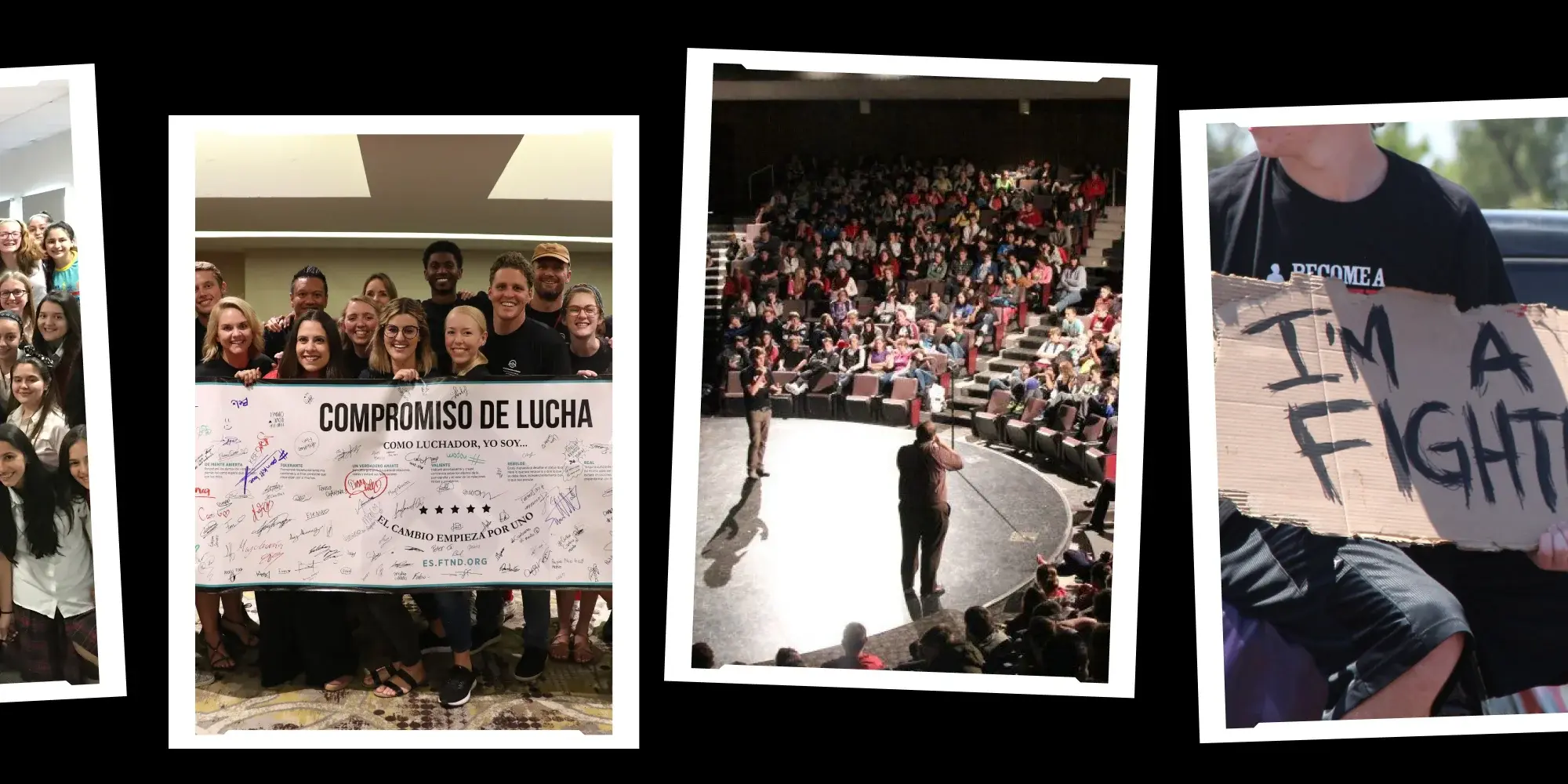
And today, because of Fighters like you, that idea, which was once laughed at, has become a global movement spanning continents and cultures, inspiring millions to stand for real love.
If you believe in a world where young people can grow up without the distortion and dangers of pornography, I invite you to join us.
Help us keep our resources free.
Help us impact students through school presentations.
Help us give a voice to survivors.
Help us spread awareness and education.
Help us make the world a better place.
This movement doesn’t grow without people like you.
Donate today and be part of the global movement for real love.
Thank you for being in this fight with me.
We’ve come a long way—but we’re just getting started.
Your Support Matters Now More Than Ever
Most kids today are exposed to porn by the age of 12. By the time they’re teenagers, 75% of boys and 70% of girls have already viewed itRobb, M.B., & Mann, S. (2023). Teens and pornography. San Francisco, CA: Common Sense.Copy —often before they’ve had a single healthy conversation about it.
Even more concerning: over half of boys and nearly 40% of girls believe porn is a realistic depiction of sexMartellozzo, E., Monaghan, A., Adler, J. R., Davidson, J., Leyva, R., & Horvath, M. A. H. (2016). “I wasn’t sure it was normal to watch it”: A quantitative and qualitative examination of the impact of online pornography on the values, attitudes, beliefs and behaviours of children and young people. Middlesex University, NSPCC, & Office of the Children’s Commissioner.Copy . And among teens who have seen porn, more than 79% of teens use it to learn how to have sexRobb, M.B., & Mann, S. (2023). Teens and pornography. San Francisco, CA: Common Sense.Copy . That means millions of young people are getting sex ed from violent, degrading content, which becomes their baseline understanding of intimacy. Out of the most popular porn, 33%-88% of videos contain physical aggression and nonconsensual violence-related themesFritz, N., Malic, V., Paul, B., & Zhou, Y. (2020). A descriptive analysis of the types, targets, and relative frequency of aggression in mainstream pornography. Archives of Sexual Behavior, 49(8), 3041-3053. doi:10.1007/s10508-020-01773-0Copy Bridges et al., 2010, “Aggression and Sexual Behavior in Best-Selling Pornography Videos: A Content Analysis,” Violence Against Women.Copy .
From increasing rates of loneliness, depression, and self-doubt, to distorted views of sex, reduced relationship satisfaction, and riskier sexual behavior among teens, porn is impacting individuals, relationships, and society worldwideFight the New Drug. (2024, May). Get the Facts (Series of web articles). Fight the New Drug.Copy .
This is why Fight the New Drug exists—but we can’t do it without you.
Your donation directly fuels the creation of new educational resources, including our awareness-raising videos, podcasts, research-driven articles, engaging school presentations, and digital tools that reach youth where they are: online and in school. It equips individuals, parents, educators, and youth with trustworthy resources to start the conversation.
Will you join us? We’re grateful for whatever you can give—but a recurring donation makes the biggest difference. Every dollar directly supports our vital work, and every individual we reach decreases sexual exploitation. Let’s fight for real love: