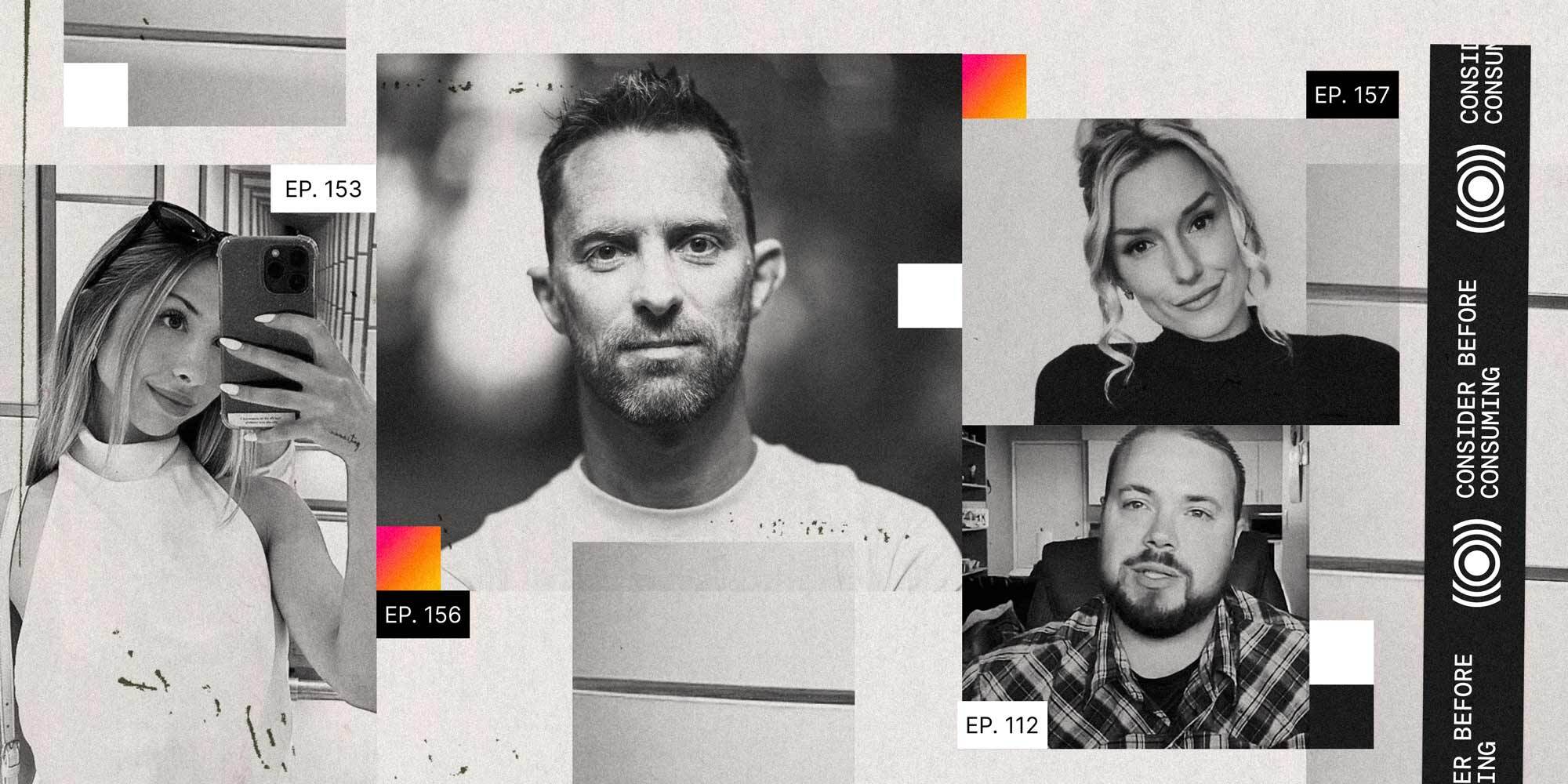
When I first started coordinating podcast interviews and editing upcoming episodes for release, I was all about logistics.
But then I started producing episodes, which started with reading story submissions.
When I started working through the many that had been submitted over the previous few months, I was taken aback. The vulnerability I witnessed in these stories brought me to tears.
Stories of people who had been struggling alone for years, caught in cycles of shame around their porn use and unsure how to break free.
Stories of partners who had been deeply impacted by a loved one’s porn habits, trying to make sense of the confusion, hurt, and betrayal.
Stories of individuals who had come to believe that sex was supposed to involve aggression, control, or even pain, because that’s what they had learned and normalized through porn.
Stories of survivors of exploitation, people whose experiences challenge the perceived realities of the porn industry, and what trafficking can actually look like.
The courage of individuals who shared in these stories is honestly something I’ve come to feel deeply grateful for, to be trusted, in part, with even a small part of someone’s story.
Speaking Up To Help Someone Else
As things have evolved, I’ve also had the opportunity to sit in on more interviews. Getting to hear these raw stories directly, in someone’s own voice, with all the nuance, emotion, and honesty they entail, has only deepened that perspective.
During these interviews, it’s easy for me to get emotional (I’m grateful to only be behind the camera). I can’t imagine the resilience it takes to experience some of the pain and healing our guests have. Their stories are sometimes difficult to hear, which makes their strength to share them all the more astounding.
That vulnerability is powerful.
It’s easy to assume that sharing your story is just about the sharer. It’s personal. But what I’ve seen, over and over again, is that when someone speaks openly, vulnerably, it has a way of reaching and impacting others in ways they may never fully see.
There’s a ripple effect.
I think about people like Robert, who, in his interview, shared that simply hearing others talk about their experiences helped him realize that change was possible for him, too.
Then Richard, who shared that hearing Robert’s episode, combined with opening up to a friend, was part of what shifted everything for him.
Or Ryan, who talked about how hearing people speak openly about their struggles gave him the confidence to start talking about his own challenges, and eventually support others in theirs.
That kind of connection is something we don’t talk about enough, but it matters. It changes lives. It creates a kind of permission, a safety net of shared experience. It shows that change is possible and that these conversations are worth having.
And just as powerfully, I think about the women who have shared their experiences of exploitation, who have spoken up about coercion, manipulation, and the realities behind what many people assume is fully consensual content.
On a call recently, I told a woman who is a trafficking survivor, “You don’t owe anyone your story.”
And that’s true, which makes us all the more grateful for those who choose to.
These survivors’ willingness to tell the truth doesn’t just create space for healing; it challenges deeply held assumptions and brings clarity to issues that are often misunderstood. I don’t think it can be overstated how much courage that takes, or how meaningful it is that they choose to share.
Their bravery gives a voice to countless others surviving the same exploitation, unsure of the words to describe what happened to them or if they are the only ones.
A Story That Makes Others Feel Seen
In each of these stories, there’s a common thread: someone was willing to be honest, and it made a difference for someone else.
We see that ripple effect not just in stories, but in the responses they spark.
One listener shared, “So happy I found your videos. I never knew the power of collective healing until recently. The power of knowing you’re not alone helps healing.”
Another commented after hearing a survivor’s story, “I always told myself those women were consenting… these conversations opened my eyes. I just wish the truth smacked me in the face much sooner.”
And another wrote, “Even after years, people like myself are finding these interviews, learning and being grateful for the bravery it takes to face it and let people know about these abuses.”
That’s the impact, both deeply personal and far-reaching.
For some, these stories break through isolation and shame. For others, they shift perspective and challenge assumptions. Often, they do both.
Because shame thrives in silence, and misunderstanding thrives in distance. When someone speaks up, it interrupts both and instead creates a connection and clarity.
And that impact isn’t limited to what’s shared publicly. We’ve heard time and time again that even opening up to one trusted person can be life-changing. The ripple effect doesn’t depend on the size of the audience. It starts with the act of being known.
That’s what makes this so meaningful to witness. Not just the stories themselves, but the willingness behind them. The choice to speak, even when it’s uncomfortable, and to trust that it might help someone else.
Because it does.
Not always in the most obvious ways, but in ways that change lives. In conversations that happen because someone feels less alone. In perspectives that shift. In people who begin to believe that change is possible.
That’s why these conversations matter. And it all starts with someone being willing to speak.
-Haley
Share Your Story
If your life has been affected by pornography or sexual exploitation and you're interested in sharing your story, we encourage you to apply to have your story featured in an article, podcast episode, or video.
Submit My StoryWe Need You to Make a Difference
At Fight the New Drug, we are privileged and honored to be a platform for the true voices of this movement; for the survivors, the advocates, the researchers, the compulsive users, the betrayed partners, the devastated and confused parents, the Fighters who believe in a world without exploitation.
This work is only possible through the support of our Fighters. Every dollar directly supports the programs that allow these voices to be heard.
Their stories reach the survivor that thinks what happened to them to couldn’t have happend to anyone else, to parents of the middle school student feeling trapped in a sextortion scheme, to the young professional who feels like they’ll never overcome their ponrography struggle, to the person who watches porn but is just realizing what they’ve been paying to watch might not be consensual and chooses to not click.
Your impact makes what we do possible. If you too believe in a world without sexual exploitation, believe in hope for healing and change, help us continue this movement and donate below.
Your Support Matters Now More Than Ever
Most kids today are exposed to porn by the age of 12. By the time they’re teenagers, 75% of boys and 70% of girls have already viewed itRobb, M.B., & Mann, S. (2023). Teens and pornography. San Francisco, CA: Common Sense.Copy —often before they’ve had a single healthy conversation about it.
Even more concerning: over half of boys and nearly 40% of girls believe porn is a realistic depiction of sexMartellozzo, E., Monaghan, A., Adler, J. R., Davidson, J., Leyva, R., & Horvath, M. A. H. (2016). “I wasn’t sure it was normal to watch it”: A quantitative and qualitative examination of the impact of online pornography on the values, attitudes, beliefs and behaviours of children and young people. Middlesex University, NSPCC, & Office of the Children’s Commissioner.Copy . And among teens who have seen porn, more than 79% of teens use it to learn how to have sexRobb, M.B., & Mann, S. (2023). Teens and pornography. San Francisco, CA: Common Sense.Copy . That means millions of young people are getting sex ed from violent, degrading content, which becomes their baseline understanding of intimacy. Out of the most popular porn, 33%-88% of videos contain physical aggression and nonconsensual violence-related themesFritz, N., Malic, V., Paul, B., & Zhou, Y. (2020). A descriptive analysis of the types, targets, and relative frequency of aggression in mainstream pornography. Archives of Sexual Behavior, 49(8), 3041-3053. doi:10.1007/s10508-020-01773-0Copy Bridges et al., 2010, “Aggression and Sexual Behavior in Best-Selling Pornography Videos: A Content Analysis,” Violence Against Women.Copy .
From increasing rates of loneliness, depression, and self-doubt, to distorted views of sex, reduced relationship satisfaction, and riskier sexual behavior among teens, porn is impacting individuals, relationships, and society worldwideFight the New Drug. (2024, May). Get the Facts (Series of web articles). Fight the New Drug.Copy .
This is why Fight the New Drug exists—but we can’t do it without you.
Your donation directly fuels the creation of new educational resources, including our awareness-raising videos, podcasts, research-driven articles, engaging school presentations, and digital tools that reach youth where they are: online and in school. It equips individuals, parents, educators, and youth with trustworthy resources to start the conversation.
Will you join us? We’re grateful for whatever you can give—but a recurring donation makes the biggest difference. Every dollar directly supports our vital work, and every individual we reach decreases sexual exploitation. Let’s fight for real love: