
For 17-year-old Gavin Guffey from North Carolina, the interaction started like many online conversations.
Someone who appeared to be a teenage girl began messaging him on social media. The conversation quickly moved to Snapchat.
Then came the request for a photo.
Within minutes of sending it, the account revealed its true intention: pay money, or the image would be sent to Gavin’s friends and family.
The threats escalated quickly.
Investigators later determined the account was connected to an international sextortion network targeting teenage boys online.United States Department of Justice, 2023Copy
Gavin died by suicide that same night, a tragedy that became part of a broader investigation into global sextortion rings targeting U.S. teens.United States Department of Justice, 2023Copy
Stories like Gavin’s are one reason law enforcement agencies are urging parents to talk with young people about sextortion and online safety.
The headlines today speak for themselves.
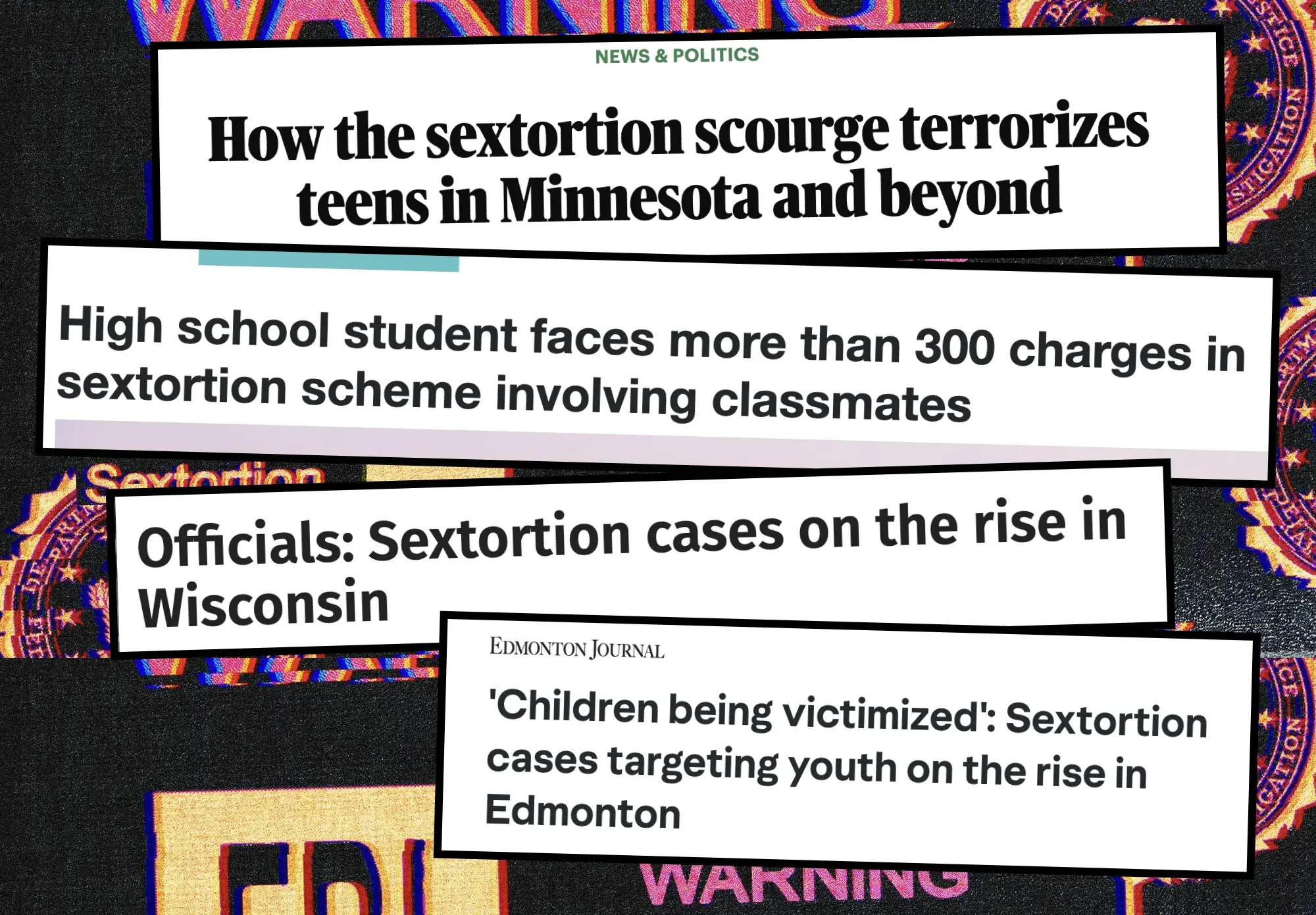
Gavin clearly isn’t alone in his experience. The same tactics are repeated over and over to exploit young, vulnerable people all over the world.
A teenager sits alone in their bedroom late at night.
Their phone lights up with another message.
The person on the other end is threatening to send a private image to everyone they know.
Friends.
Family.
Classmates.
Unless they send more money. Unless they send another image.
This is the pattern of sextortion, one of the fastest-growing forms of online exploitation targeting young people today.
The FBI recently issued a warning to parents and communities across the United States about the rise of sextortion schemes targeting minors, explaining that offenders often operate from organized cybercrime networks and can contact hundreds of teens at once.Federal Bureau of Investigation. (2024). On Safer Internet Day, FBI warns about the dangers of sextortion schemes against minors.Copy
They also warn that these types of financial sextortion have been linked to numerous youth suicides. Victims often experience intense fear, shame, and panic, which can make the situation feel impossible to escape. The FBI stresses that victims are not in trouble and should seek help immediately.
It’s critical we understand how these schemes work—and how to respond—can make a life-saving difference.
When a Stranger Pretends to Be a Teen
In another case investigated by federal authorities, a California teenager believed he was communicating with a girl his age on Instagram.
The conversation became flirtatious, and the person encouraged him to move the chat to Snapchat.
After the teen sent an intimate image, the messages changed.
The person behind the account threatened to send the image to the teen’s followers unless he paid hundreds of dollars through a payment app.
The teenager told investigators he felt trapped and terrified that his classmates would see the image.Federal Bureau of Investigation. (2024). On Safer Internet Day, FBI warns about the dangers of sextortion schemes against minors.Copy
Law enforcement officials say this pattern is extremely common in sextortion cases.
Offenders build trust quickly, then use fear and urgency to pressure victims before they have time to seek help.
A Teen Who Reported the Scam
Not every sextortion story ends in tragedy.
In one FBI-reported case, a 15-year-old boy in the Midwest was contacted by someone posing as a teenage girl through a social media platform.
The person quickly began asking personal questions and encouraging the teen to exchange explicit photos.
When the threats began, the teen remembered advice from an online safety presentation at his school.
Instead of responding further, he told his parents.
The family reported the account to law enforcement, and investigators were able to connect the scam to a broader sextortion operation targeting multiple minors.Federal Bureau of Investigation. (2019). Stop sextortion: Youth face risk online.Copy
Child safety experts say this case highlights an important reality:
Education and open communication can make a major difference in preventing harm.
When Sextortion Targets an Entire Friend Group
In some cases, offenders target multiple teens connected through the same social network.
According to investigators, a sextortion scam uncovered in the Midwest involved offenders creating fake profiles and messaging several teenagers from the same high school.
Once the offender received an image from a victim, they used the teen’s follower list to identify additional potential victims.
The scam expanded rapidly, with several students receiving threatening messages within hours.
Law enforcement officials say this type of targeting shows how quickly sextortion can spread across online communities.
What Is Sextortion?
Sextortion is a form of online exploitation where someone threatens to share sexual images or videos of a victim unless the victim complies with demands such as sending additional images or paying money.Federal Bureau of Investigation. (2019). Stop sextortion: Youth face risk online.Copy
In many cases involving teenagers, offenders pretend to be peers on social media platforms.
Once a victim sends an explicit image, the offender threatens to distribute the content to the victim’s friends, family members, or social media followers.
These threats are designed to create panic and prevent victims from seeking help.
Sextortion By the Numbers
Recent law enforcement data illustrates how widespread sextortion has become.
• Thousands of sextortion complaints involving minors are reported to the FBI each year.Federal Bureau of Investigation. (2024). On Safer Internet Day, FBI warns about the dangers of sextortion schemes against minors.Copy
• Many victims are teen boys between ages 14 and 17, though girls are also targeted.Federal Bureau of Investigation, 2024Copy
• Investigators have identified organized cybercrime networks responsible for contacting hundreds of victims simultaneously.
• The National Center for Missing & Exploited Children has documented a significant increase in reports of online enticement involving minors, including sextortion.National Center for Missing & Exploited Children. (2023). CyberTipline ReportCopy
What Child Safety Experts Are Saying
Child safety organizations and investigators have been warning families about sextortion for years.
The FBI notes that many victims initially believe they are talking to another teenager online, only to discover that the account is controlled by an adult scammer or organized criminal group.
“These criminals target hundreds of victims at once and quickly escalate threats to create panic,” the FBI explains in its guidance for parents and youth.Federal Bureau of Investigation. (2019). Stop sextortion: Youth face risk online.Copy
Child protection experts also warn that predators often rely on emotional manipulation.
The National Center for Missing & Exploited Children reports that offenders frequently use fear, shame, and urgency to prevent victims from telling trusted adults.National Center for Missing & Exploited Children, 2023Copy
Awareness and open communication can significantly reduce these risks.
How To Talk About Sextortion Before It Happens
One of the most effective ways to protect young people from sextortion is talking about it before they encounter it online.
These conversations don’t need to be long or complicated. Short, ongoing discussions about online safety can help teens recognize warning signs and feel comfortable asking for help if something feels wrong.
The FBI encourages parents and caregivers to talk openly with young people about how online interactions work and how predators sometimes manipulate people through social media, gaming platforms, and messaging apps.
A helpful place to start is by sharing a few simple ideas teens can remember when they’re online.
Key Things To Talk About With Your Kids
-
Be careful what you share publicly.
If social media accounts are open to everyone, strangers may be able to see photos, school names, locations, or friend lists that reveal personal information. -
Not everyone online is who they say they are.
Photos, videos, and profiles can be stolen or altered. In some cases, offenders even take over real accounts and impersonate the account owner. -
Be cautious when someone asks to move the conversation.
If someone you met on one app or game asks to switch to another platform, it can sometimes be a warning sign. -
Nothing truly disappears online.
Even apps that advertise disappearing messages cannot guarantee privacy. Screenshots and recordings can save content instantly. -
Block and ignore suspicious messages.
If someone you don’t know sends uncomfortable or strange messages, it’s okay to block them or report the behavior. -
Always ask for help if something feels wrong.
Teens should know they can talk to a parent, teacher, or trusted adult if they receive messages or requests that make them uncomfortable.
Perhaps the most important message parents can share is this: no mistake online is too big to ask for help.
If a young person ever finds themselves being threatened or pressured online, they should know they will not be blamed or shamed for speaking up. Reporting suspicious activity can help investigators identify offenders and prevent them from targeting other young people.
Creating a home environment where teens feel safe talking about their online experiences can make a powerful difference in preventing sextortion and other forms of digital exploitation.
Warning Signs a Teen Might Be Experiencing Sextortion
Because victims often hide what’s happening, adults may notice subtle behavioral changes first.
Possible warning signs include:
- sudden anxiety around phones or social media
- panic when receiving messages
- withdrawal from friends or activities
- requests for money
- increased secrecy online
- emotional distress after using devices
These signals don’t automatically mean sextortion is occurring, but they may indicate that a young person is experiencing online pressure.
What Teens Should Do If Sextortion Happens
According to the FBI, teens experiencing sextortion should take several steps immediately.
1. Stop communicating with the offender
Continuing the conversation often encourages further threats and demands.
2. Save evidence
Take screenshots of messages, usernames, and profiles. This information can help investigators identify and stop offenders.
3. Do not send money
Paying scammers rarely stops the threats. In many cases, offenders simply demand more money afterward.
4. Tell a trusted adult
Parents, teachers, counselors, or other trusted adults can help contact authorities and provide support during the situation.
5. Report the incident
Law enforcement and child protection organizations can help investigate sextortion cases and prevent offenders from targeting additional victims.
What Parents Can Do to Protect Kids
Parents and caregivers play a critical role in prevention.
Experts recommend several steps.
Start conversations early
Discuss online safety before teens begin using social media platforms.
Emphasize that mistakes don’t eliminate support
Young people should know they can ask for help even if they made a mistake online.
Encourage critical thinking online
Remind teens that people online may not always be who they claim to be.
Review privacy settings together
Limiting contact from strangers can reduce risk.
Normalize asking for help
One of the most powerful protective messages a parent can offer is simple:
“If something goes wrong online, you can come to me and we’ll handle it together.”
A Simple Script for Starting the Conversation
For many parents, discussing sextortion can feel uncomfortable.
But starting the conversation doesn’t have to be complicated.
You might begin with something like:
“Hey, I recently read about a scam where people pretend to be teens online and pressure kids into sending photos. If something like that ever happened to you or someone you know, you could always come talk to me. We’d figure it out together.”
The goal isn’t to lecture—it’s to create an environment where teens feel safe asking for help.
What to Do If Your Child Is Being Sextorted
If you discover that a young person is experiencing sextortion, experts recommend the following steps.
- Stay calm. Responding calmly helps your child feel safe sharing information.
- Stop communication with the offender. Block the account after saving evidence.
- Preserve evidence, keep screenshots, and account details.
- Report the incident. Report to the appropriate authorities.
- Seek emotional support. Victims may benefit from counseling or mental health support.
- Reporting Sextortion. If you or someone you know is experiencing sextortion, these organizations can help.
FBI Internet Crime Complaint Center (IC3)
https://www.ic3.gov
National Center for Missing & Exploited Children CyberTipline
https://report.cybertip.org
Take It Down
Why Awareness Matters
Sextortion thrives in silence.
When families understand how these scams work, they are better prepared to recognize warning signs and support young people navigating online spaces.
Open conversations, education, and supportive relationships can make a powerful difference.
And for any teen facing sextortion, the most important message remains clear:
You are not alone—and help is available.
Your Support Matters Now More Than Ever
Most kids today are exposed to porn by the age of 12. By the time they’re teenagers, 75% of boys and 70% of girls have already viewed itRobb, M.B., & Mann, S. (2023). Teens and pornography. San Francisco, CA: Common Sense.Copy —often before they’ve had a single healthy conversation about it.
Even more concerning: over half of boys and nearly 40% of girls believe porn is a realistic depiction of sexMartellozzo, E., Monaghan, A., Adler, J. R., Davidson, J., Leyva, R., & Horvath, M. A. H. (2016). “I wasn’t sure it was normal to watch it”: A quantitative and qualitative examination of the impact of online pornography on the values, attitudes, beliefs and behaviours of children and young people. Middlesex University, NSPCC, & Office of the Children’s Commissioner.Copy . And among teens who have seen porn, more than 79% of teens use it to learn how to have sexRobb, M.B., & Mann, S. (2023). Teens and pornography. San Francisco, CA: Common Sense.Copy . That means millions of young people are getting sex ed from violent, degrading content, which becomes their baseline understanding of intimacy. Out of the most popular porn, 33%-88% of videos contain physical aggression and nonconsensual violence-related themesFritz, N., Malic, V., Paul, B., & Zhou, Y. (2020). A descriptive analysis of the types, targets, and relative frequency of aggression in mainstream pornography. Archives of Sexual Behavior, 49(8), 3041-3053. doi:10.1007/s10508-020-01773-0Copy Bridges et al., 2010, “Aggression and Sexual Behavior in Best-Selling Pornography Videos: A Content Analysis,” Violence Against Women.Copy .
From increasing rates of loneliness, depression, and self-doubt, to distorted views of sex, reduced relationship satisfaction, and riskier sexual behavior among teens, porn is impacting individuals, relationships, and society worldwideFight the New Drug. (2024, May). Get the Facts (Series of web articles). Fight the New Drug.Copy .
This is why Fight the New Drug exists—but we can’t do it without you.
Your donation directly fuels the creation of new educational resources, including our awareness-raising videos, podcasts, research-driven articles, engaging school presentations, and digital tools that reach youth where they are: online and in school. It equips individuals, parents, educators, and youth with trustworthy resources to start the conversation.
Will you join us? We’re grateful for whatever you can give—but a recurring donation makes the biggest difference. Every dollar directly supports our vital work, and every individual we reach decreases sexual exploitation. Let’s fight for real love: