Trigger warning: This article contains mature, offensive, and sexually explicit language. Reader discretion is advised.
“Btch shut the fck up. I would rape you to death.”
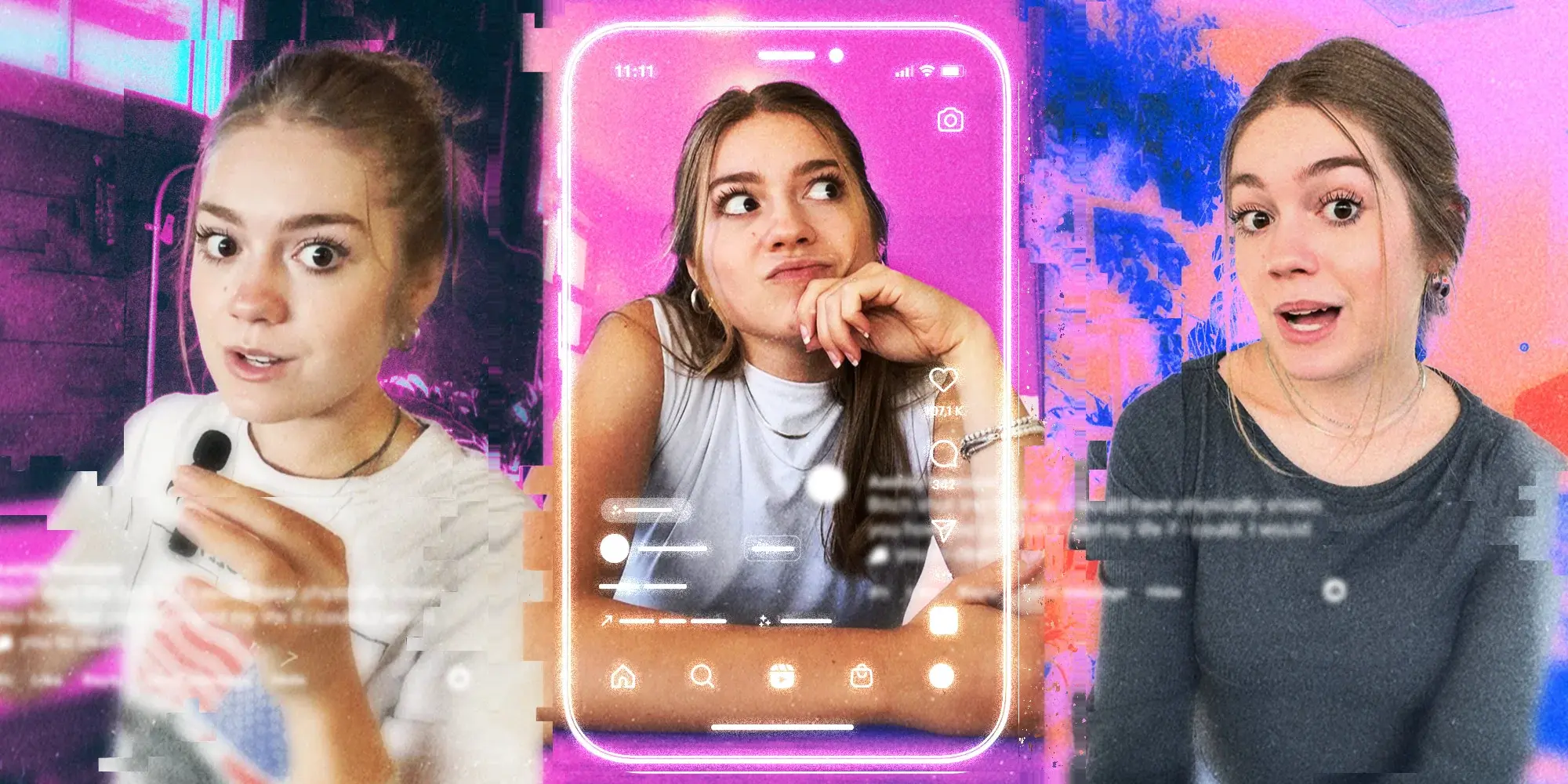
I remember the exact moment I saw that comment posted under an educational video I filmed of myself.
I was completely shaken.
Since starting my role at Fight the New Drug and working largely in social media, I’ve encountered tens of thousands of hateful messages — but this was the first one directed at me.
As I stared at the message, I felt my eyes start to well, and my throat start to tighten. But I pulled it together and kept scrolling… only to find several more comments that harassed me sexually. And while I knew they were “just words,” and that the people behind the screen couldn’t physically hurt me, it was absolutely devastating and felt just as real.
I slipped away to the bathroom, where I quietly sobbed until I could handle going back to my desk.
Since taking on content creation and moderation for our largely social media-driven movement, I have never witnessed so much cruelty and dehumanization in my life. It’s a lot for one person to experience — even if it’s happening on the other side of a screen.
And it’s not just about me.
Some of the messages are directed specifically at me. Many more target survivors of trafficking or abuse that our organization has supported.
Comments about trafficking survivors like: *reader discretion advised*
“I don’t believe her. I think she was being super difficult, and she brought a lot of that on herself, not the assault stuf,f but you can tell she was being difficult, and you reap what you sow.”
“She was sex trafficked by GirlsDoPorn? Oh no, how terrible! What’s the video URL to her porn?”
“Yeah, I never thought about how ‘painful’ it would be to do a porn shoot. But at the end of the day, I really DON’T CARE while I have my d*ck in my hand.”
“Why is she talking? I like my porn performers on their back or all fours. Not talking! “Imagine being stupid enough to believe these willing whores were victims of sex trafficking.”
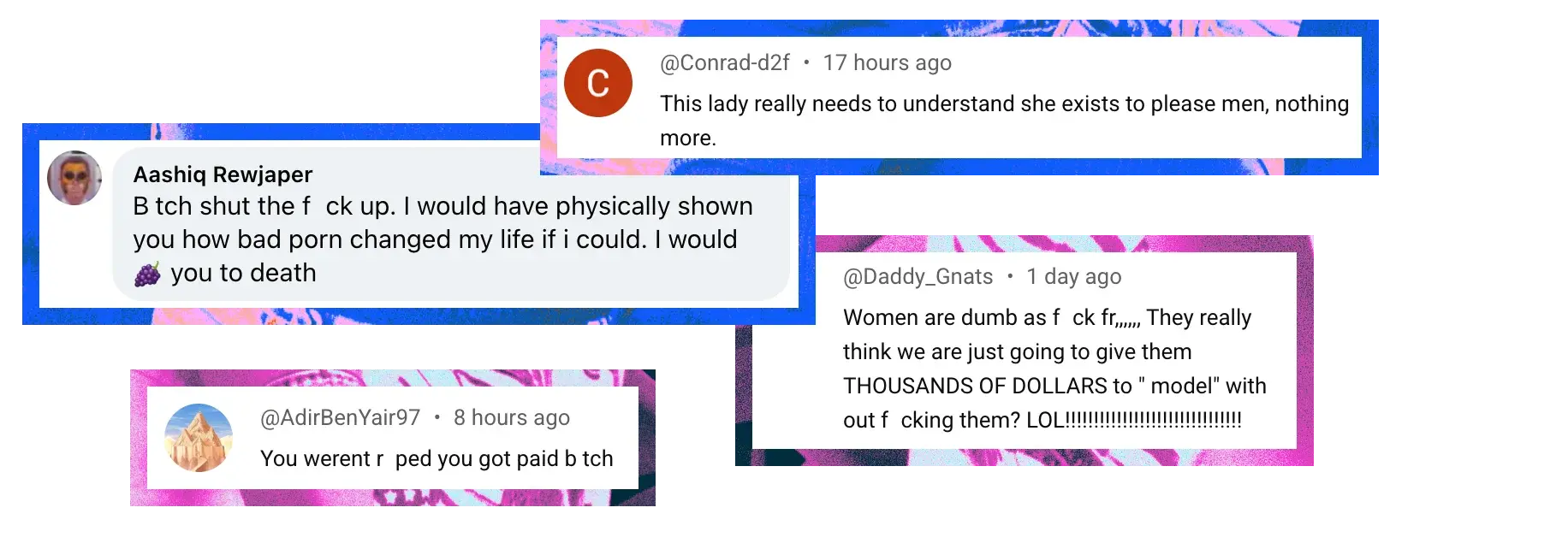 I see survivors who were manipulated, coerced, lied to, and exploited — being mocked for speaking out.
I see a culture that has grown so desensitized that it treats real human trauma like entertainment.
When friends or family check in on me, I usually say something like, “It’s hard, but I’m fine. I compartmentalize the worst stuff so it doesn’t come home with me.” And that’s not entirely inaccurate. I’ve definitely had to build healthy boundaries for my own mental health.
But sometimes it’s not as simple as that.
Some of the experiences I’ve had will never leave me. I worry about the state of our world, filled with so much hate. I worry for the survivors I see being harassed online. I fear for the hundreds of people messaging us for help. I worry about my own safety being a face for an organization built on such a controversial topic.
I’d be lying if I said I didn’t regularly Google myself to make sure my personal information hasn’t been leaked. Or that the AI deepfakes some commenters claimed to have made of me haven’t surfaced somewhere online.
I know I’m not alone in these worries. Maybe you’ve felt something similar scrolling through social media lately. Maybe you’ve experienced your own forms of hate and harassment.
Research shows that more than half of Americans have faced harassment online Hickey, D., T. Fessler, D. M., Lerman, K., & Burghardt, K. (2025). X under Musk’s leadership: Substantial hate and no reduction in inauthentic activity. PLOS ONE, 20(2), e0313293. https://doi.org/10.1371/journal.pone.0313293Copy , and hate speech has increased significantly in recent years. The United Nations has even warned that toxic digital spaces are influencing real-world attitudes and behaviorsUnited Nations. (2025). UN Women sounds alarm over online misogyny. https://www.un.org/en/delegate/un-women-sounds-alarm-over-online-misogynyCopy .
This isn’t “just the internet.”
It’s shaping how people see each other.
And once you see it clearly, you can’t unsee it.
That doesn’t mean it’s easy to keep going. It can feel overwhelming — even paralyzing. When hate is this loud and this normalized, it’s easy to feel powerless.
Trust me. I know.
But real change doesn’t start with “everyone.” It starts with someone.
For me, that means continuing to show up. Continuing to create impactful messages and share them — even when it’s scary.
Because for every hateful comment, we receive just as many messages of hope:
“Thank you for your encouragement! After watching this interview, I decided that I couldn’t continue this habit knowing it caused THIS much harm to innocent people. I’ve done my best to share the truth with the people in my life and to share this story, too. I deeply believe in y’all’s mission.”
“It’s great when the desire comes to us, we see a notification for your channel, and we go to watch the video, and the desire goes away, and we become better.”
“This is a movement society doesn’t know it needs yet, but it’s doing so much for LOVE. Keep fighting this fight. Thank you, and we’re here fighting with you.”
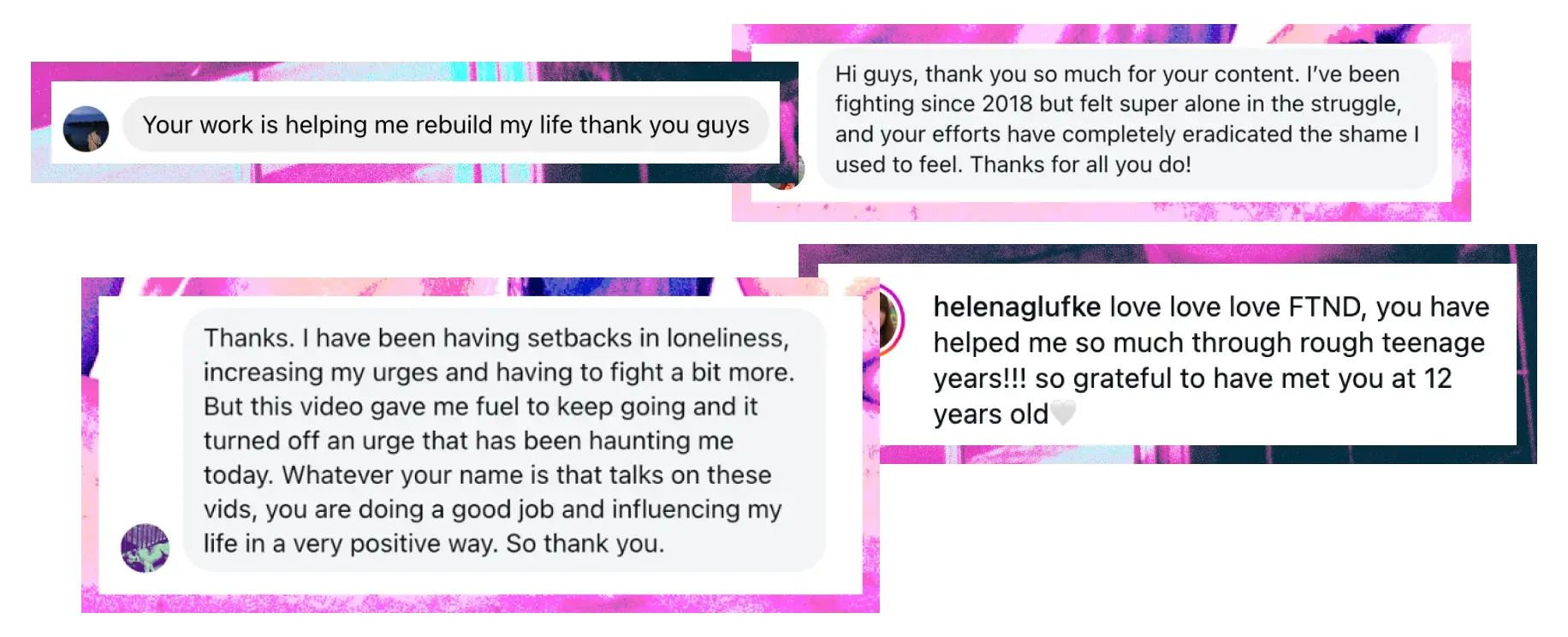 I know this movement, our work at Fight the New Drug is impacting people’s lives. I’ve seen it.
It’s the ‘hater’ who unexpectedly responds with gratitude after we take the time to explain and share resources.
It’s the mom thanking us for giving her the tools to educate her children.
It’s the teenage sextortion victim whom we’re able to provide healing resources for.
It’s the Fighter who reaches out years later and says they “finally did it” and are living a porn-free life.
Fighting the New Drug isn’t just about saying no to porn. It’s about taking actionable steps to reassert the dignity and value of every single human being.
It’s choosing to treat people like people — even when the rest of the world says it’s fine not to.
It’s responding to hate with empathy, even when you don’t expect any in return.
We can shape the kind of world we live in — not just with our beliefs, but with our actions.
If you’re scared for the world your kids are growing up in, you don’t have to wait for someone else to fix it.
If you’re hurting for survivors who are retraumatized and mocked for speaking out, that feeling can become fuel for change.
Treat people like people.
That’s what this movement is all about.
But we can’t do it alone.
When you donate to Fight the New Drug, you’re doing more than giving money. You’re standing up against a culture that dehumanizes, exploits, and silences. You’re helping us educate, change lives, and transform the way society treats human beings.
If you believe love is worth fighting for, join us.
Together, we can make a difference.
Your Support Matters Now More Than Ever
Most kids today are exposed to porn by the age of 12. By the time they’re teenagers, 75% of boys and 70% of girls have already viewed itRobb, M.B., & Mann, S. (2023). Teens and pornography. San Francisco, CA: Common Sense.Copy —often before they’ve had a single healthy conversation about it.
Even more concerning: over half of boys and nearly 40% of girls believe porn is a realistic depiction of sexMartellozzo, E., Monaghan, A., Adler, J. R., Davidson, J., Leyva, R., & Horvath, M. A. H. (2016). “I wasn’t sure it was normal to watch it”: A quantitative and qualitative examination of the impact of online pornography on the values, attitudes, beliefs and behaviours of children and young people. Middlesex University, NSPCC, & Office of the Children’s Commissioner.Copy . And among teens who have seen porn, more than 79% of teens use it to learn how to have sexRobb, M.B., & Mann, S. (2023). Teens and pornography. San Francisco, CA: Common Sense.Copy . That means millions of young people are getting sex ed from violent, degrading content, which becomes their baseline understanding of intimacy. Out of the most popular porn, 33%-88% of videos contain physical aggression and nonconsensual violence-related themesFritz, N., Malic, V., Paul, B., & Zhou, Y. (2020). A descriptive analysis of the types, targets, and relative frequency of aggression in mainstream pornography. Archives of Sexual Behavior, 49(8), 3041-3053. doi:10.1007/s10508-020-01773-0Copy Bridges et al., 2010, “Aggression and Sexual Behavior in Best-Selling Pornography Videos: A Content Analysis,” Violence Against Women.Copy .
From increasing rates of loneliness, depression, and self-doubt, to distorted views of sex, reduced relationship satisfaction, and riskier sexual behavior among teens, porn is impacting individuals, relationships, and society worldwideFight the New Drug. (2024, May). Get the Facts (Series of web articles). Fight the New Drug.Copy .
This is why Fight the New Drug exists—but we can’t do it without you.
Your donation directly fuels the creation of new educational resources, including our awareness-raising videos, podcasts, research-driven articles, engaging school presentations, and digital tools that reach youth where they are: online and in school. It equips individuals, parents, educators, and youth with trustworthy resources to start the conversation.
Will you join us? We’re grateful for whatever you can give—but a recurring donation makes the biggest difference. Every dollar directly supports our vital work, and every individual we reach decreases sexual exploitation. Let’s fight for real love: