Immy, 15, met a 16-year-old boy, Max, on Wizz.
Wizz is a social media platform designed primarily for teens and young adults. It mimics the Tinder-style swiping through users’ profiles to connect people. Their website claims the goal is to match you with “like-minded peers all over the country.”
As Max and Immy started talking on Wizz, Max charmed her with compliments and admiration. Eventually, Immy started to trust him; after all, the platform boasted that it would only connect you with teens in your age group, so they moved their conversation to Snapchat.
Max then started asking for explicit images of Immy.
“I didn’t want him to stop talking to me, and I didn’t want him to stop giving me that attention,” Immy told NCOSE.
After receiving the photos, their once innocent conversation turned into blackmail, sextortion, and exploitation.
Max threatened to leak the photographs of Immy to her friends and family if she didn’t send him money. Thankfully, Immy was brave enough to share what had happened with her mom.
Come to find out, Max, whose profile said he was 16, was actually a 21-year-old with a vendetta to exploit children.
Thankfully, Max was eventually arrested, while Immy is left to live with the pain and trauma of being exploited and blackmailed.
“I will always be angry at him for taking away my innocence,” Immy says.
Unfortunately, her experience of exploitation is one of many.
Various reports include adults from ages 19 to 27 pretending to be kids or teens, only to rape kids as young as 11 and 12.
Wizz’s Safety Controls
Wizz has received significant negative media attention over its failure to protect kids on its platform, and while it updated the app store age rating from 13 to 17, its website still advertised that it welcomes users aged 13 to 34. On top of that, its verification system continues to prove ineffective, as adult employees at NCOSE were able to create accounts posing as minors.
The company claims that they rely on artificial intelligence and facial analysis—yet they have repeatedly failed to prevent adults from creating accounts as minors.
Once inside the app, these adults can message children directly, often without meaningful friction or timely intervention.
Legal filings and reporting compiled by LitigationConnect describe similar allegations from families across the United States, including claims that Wizz failed to adequately moderate content, respond quickly to reports, or prevent known forms of online sexual exploitation such as grooming and sextortion.
These reports point to a troubling reality: the harm associated with Wizz is not hypothetical, rare, or unforeseeable. It follows well-documented patterns of online exploitation that child-safety experts have been warning about for years.
Why Critics Call Wizz “Tinder for Kids”
One of the most persistent criticisms of Wizz centers on its design.
Wizz uses a swipe-based, photo-first interface that closely resembles adult dating apps. Users are encouraged to judge profiles quickly, initiate private conversations, and connect with strangers based largely on appearance.
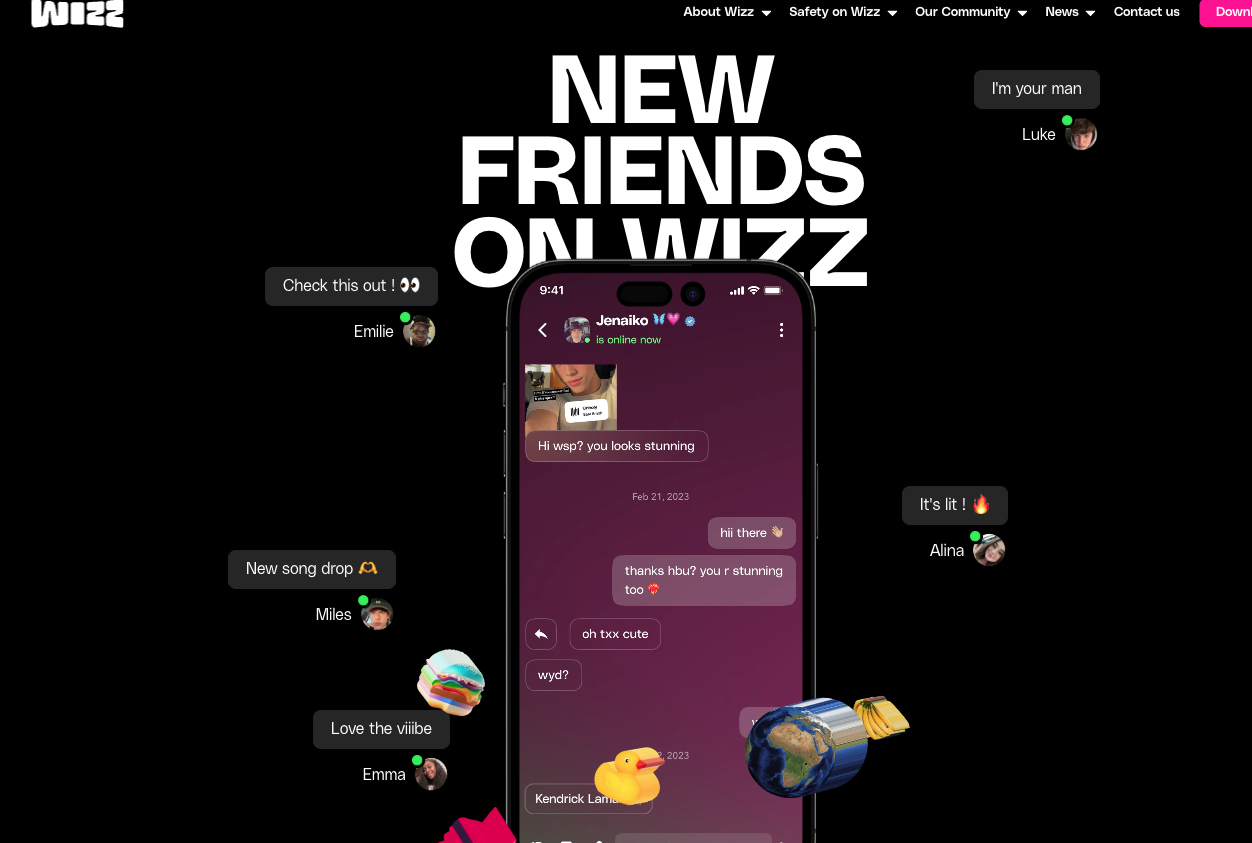
While these mechanics of swiping and chatting online are normalized in adult spaces, experts argue they are fundamentally unsafe when applied to platforms used by minors.
This design choice has earned Wizz the label “Tinder for kids”—a phrase that reflects concern not just about who is on the app, but also about how it functions.
Child-safety advocates note that dating-style features can:
- Reduce protective friction between minors and strangers
- Encourage rapid escalation to private messaging
- And create ideal conditions for grooming behaviors, which often rely on secrecy, flattery, and quick emotional intimacy
In this context, weak age verification does more than fail to protect children—it actively amplifies risk by placing minors into an environment optimized for fast, image-based connection with unknown users.
Warnings, Reports, and Platform Accountability
Concerns about Wizz escalated to the point that, in early 2024, Apple and Google temporarily removed the app from their app stores following reports that it had been linked to sextortion schemes and child sexual exploitation.
Although Wizz was later reinstated after announcing updated safety measures, critics argue that these changes lack transparency and enforceability. NCOSE has stated that the platform’s assurances do not address the underlying structural risks created by its design and verification systems.
If a staff member with a full head of grey hair and matching beard can get into Wizz posing as a 15-year-old, something isn’t working.
At Fight the New Drug, we are non-religious and non-legislative, and we support efforts to protect children against all forms of sexual exploitation. Wizz has become a playground for predators where kids are at risk of sexual exploitation.
The Bigger Picture
The children exploited on Wizz reflect a broader issue facing today’s digital landscape: when platforms designed for connection are built without rigorous child-safety protections, they can quickly become tools for exploitation.
The case documented by NCOSE makes one thing clear—children do not need to seek out dangerous spaces to be harmed online. Sometimes, those spaces are marketed directly to them as safe, fun, and social.
As lawmakers, parents, and advocates continue to debate how best to protect young people online, the experiences tied to Wizz serve as a stark reminder that platform design matters, safeguards matter, and accountability matters.
For minors navigating digital spaces, the cost of getting it wrong is far too high.
Your Support Matters Now More Than Ever
Most kids today are exposed to porn by the age of 12. By the time they’re teenagers, 75% of boys and 70% of girls have already viewed itRobb, M.B., & Mann, S. (2023). Teens and pornography. San Francisco, CA: Common Sense.Copy —often before they’ve had a single healthy conversation about it.
Even more concerning: over half of boys and nearly 40% of girls believe porn is a realistic depiction of sexMartellozzo, E., Monaghan, A., Adler, J. R., Davidson, J., Leyva, R., & Horvath, M. A. H. (2016). “I wasn’t sure it was normal to watch it”: A quantitative and qualitative examination of the impact of online pornography on the values, attitudes, beliefs and behaviours of children and young people. Middlesex University, NSPCC, & Office of the Children’s Commissioner.Copy . And among teens who have seen porn, more than 79% of teens use it to learn how to have sexRobb, M.B., & Mann, S. (2023). Teens and pornography. San Francisco, CA: Common Sense.Copy . That means millions of young people are getting sex ed from violent, degrading content, which becomes their baseline understanding of intimacy. Out of the most popular porn, 33%-88% of videos contain physical aggression and nonconsensual violence-related themesFritz, N., Malic, V., Paul, B., & Zhou, Y. (2020). A descriptive analysis of the types, targets, and relative frequency of aggression in mainstream pornography. Archives of Sexual Behavior, 49(8), 3041-3053. doi:10.1007/s10508-020-01773-0Copy Bridges et al., 2010, “Aggression and Sexual Behavior in Best-Selling Pornography Videos: A Content Analysis,” Violence Against Women.Copy .
From increasing rates of loneliness, depression, and self-doubt, to distorted views of sex, reduced relationship satisfaction, and riskier sexual behavior among teens, porn is impacting individuals, relationships, and society worldwideFight the New Drug. (2024, May). Get the Facts (Series of web articles). Fight the New Drug.Copy .
This is why Fight the New Drug exists—but we can’t do it without you.
Your donation directly fuels the creation of new educational resources, including our awareness-raising videos, podcasts, research-driven articles, engaging school presentations, and digital tools that reach youth where they are: online and in school. It equips individuals, parents, educators, and youth with trustworthy resources to start the conversation.
Will you join us? We’re grateful for whatever you can give—but a recurring donation makes the biggest difference. Every dollar directly supports our vital work, and every individual we reach decreases sexual exploitation. Let’s fight for real love: